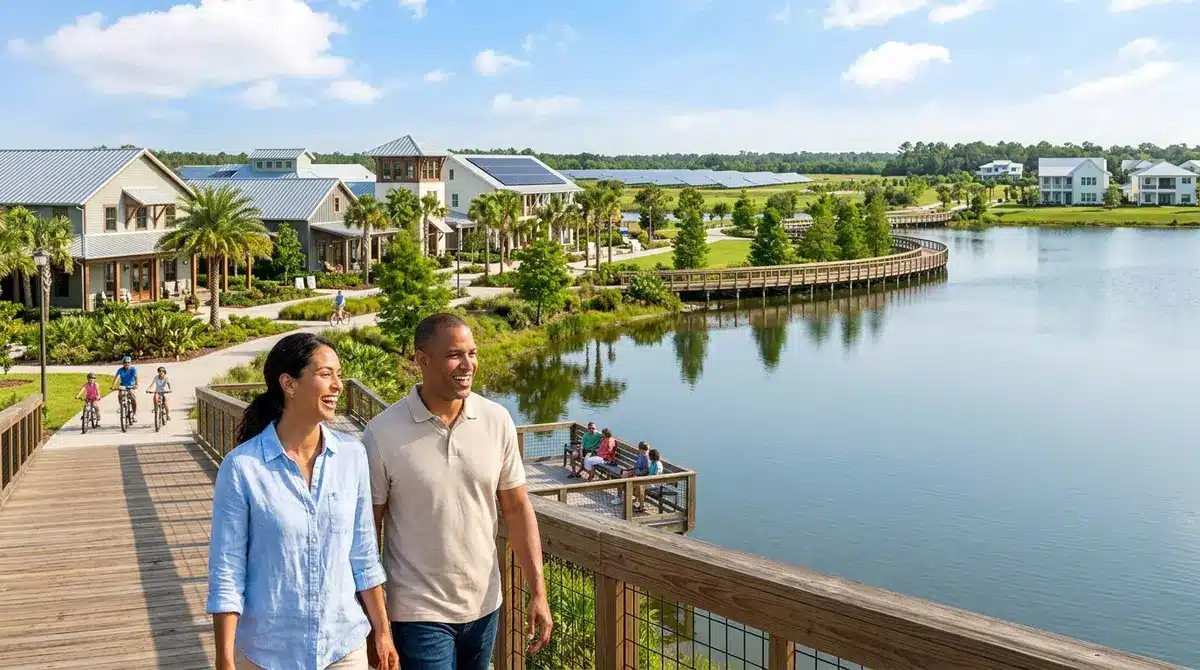

When you drive into Babcock Ranch in 2026, the first thing you notice isn’t the architectural beauty of the homes or the sprawling blue lakes. It is the shimmer of glass stretching across the horizon, reflecting the bright Florida sun. You are looking at the Babcock Ranch Solar Field, the high-tech engine that drives America’s first solar-powered town.
For many of you looking to move to Southwest Florida, this solar infrastructure is a major draw. It represents a tangible commitment to sustainability and a futuristic way of living that prioritizes resilience. However, it also raises practical questions: Does it lower my electric bill? Who maintains it? How did it perform during the record-breaking hurricanes of recent years?
We believe that understanding this massive infrastructure is key to grasping the true value of your potential home. It is not just a utility plant; it is the reason our lights stayed on when the rest of the region went dark. As local real estate experts, we help buyers like you understand how this grid connects to your daily life and your long-term property investment.
Key Takeaways for Potential Buyers and Residents

- Massive Scale: The facility spans approximately 870 acres and contains nearly 700,000 solar panels, making it one of the largest utility-scale solar projects integrated into a residential community.
- Two High-Tech Centers: The field is comprised of two distinct Florida Power & Light (FPL) plants: the Babcock Ranch Solar Energy Center and the Babcock Preserve Solar Energy Center.
- Innovative Battery Storage: The site features a 10-megawatt solar-plus-storage system, ensuring the town has a steady power supply even after the sun sets.
- Proven Resilience: During Hurricane Ian (2022) and Hurricane Milton (2024), the solar field and underground utilities kept the community 100% powered while millions elsewhere lost electricity.
- The “Safety Premium”: Knowing your source of power is hardened against storms adds significant value to Babcock Ranch resale homes.
A Deep Dive into the Infrastructure of America’s First Solar Town

The Babcock Ranch Solar Field is not a gimmick or a small-scale pilot project. It is a utility-scale power plant integrated directly into the community’s master plan from the very first shovel in the ground. By 2026, the town has reached a population of over 15,000 residents, and the solar field continues to produce more energy than the community consumes.
The FPL Partnership: How Utility-Scale Solar Works
The developer, Kitson & Partners, made a historic decision to donate the land to Florida Power & Light (FPL). FPL, in turn, built and operates the solar centers. This model is highly beneficial for homeowners for several reasons:
- Zero Maintenance for Residents: You do not have to worry about the cost of cleaning or repairing the panels. That is FPL’s responsibility, and it is not passed on through HOA or CDD fees.
- Reliability: Because FPL manages the site, it is monitored 24/7. The energy generated flows directly into the regional grid. During the day, the town is effectively “running on sunshine.”
- Doubling Down on Power: With the addition of the Babcock Preserve Solar Energy Center, the total capacity reached 150 megawatts, which is enough to power approximately 30,000 homes—well beyond the town’s planned build-out.
Battery Storage: The Solution for 24/7 Clean Energy
Solar power has historically faced the “intermittency” challenge—what happens when it rains or when the moon is out? Babcock Ranch solved this by hosting the largest solar-plus-battery storage system in the U.S. at the time of its opening.
- The Technology: Ten massive grey containers house lithium-ion batteries that store excess solar energy generated during peak hours.
- The Function: When clouds roll in or night falls, these batteries discharge energy, maintaining a stable and consistent “micro-grid” capability.
- Stability: This prevents the power surges and dips that can often occur in traditional grids during peak Florida summer demand.
The Resilience Test: Surviving Hurricane Ian and Hurricane Milton
The true value of the Babcock Ranch Solar Field became global news in September 2022. Hurricane Ian struck Southwest Florida as a near-Category 5 storm. While nearby cities like Fort Myers and Cape Coral faced catastrophic blackouts that lasted for weeks, Babcock Ranch did not lose power for a single minute.
Why the Solar Grid Stayed On
This wasn’t luck; it was engineering.
- Hardened Panels: The panels are mounted on racking systems engineered to withstand 150+ mph winds. The damage to the array from Ian was essentially negligible.
- The Islanding Effect: Because the town has its own generation and storage, it can “island” itself from the main regional grid if external transmission lines are damaged.
- Resilience as an Amenity: For a homebuyer, this is the “Safety Premium.” Knowing your family won’t be trapped in a humid, dark house after a storm is a primary reason for the high satisfaction ratings among current residents.
Why Underground Transmission Lines are the Real Hero
While the solar panels get the headlines, the undergrounding of the infrastructure is what secures the home. In most traditional neighborhoods, power lines are suspended on wooden poles. In Babcock Ranch, every power and fiber-optic line is buried.
- Wind Protection: There are no lines for falling trees to snap.
- Aesthetic Value: Without telephone poles and messy wires, the neighborhood streetscapes remain pristine and park-like.
Understanding the Financial Reality: Solar Power and Your Utility Bill
One of the most common misconceptions we address is that residents get “free” electricity. It is important to be clear about the 2026 utility structure.
The Bill Breakdown
Residents in Babcock Ranch are FPL customers and pay standard rates. You do not receive a credit simply for living near the solar field. However, your total bill is typically much lower than it would be for a comparable home elsewhere in Charlotte or Lee County.
How Energy Efficiency Standards Amplify Solar Benefits
Every home in Babcock Ranch must meet the Florida Green Building Coalition (FGBC) standards. This means:
- Superior Insulation: Spray foam or high-R-value materials keep the cool air in.
- Impact Windows: These aren’t just for storms; they provide incredible thermal insulation, blocking out the Florida heat.
- Efficient HVAC: Builders use high-efficiency units that work in tandem with the town’s grid to minimize consumption. You can see how these features vary by builder in our construction quality comparison.
The Solar Ranch Eco-Discovery Center: Education and Observation
If you want to see the scale of this project with your own eyes, a visit to Solar Ranch is essential. Located on the north side of the community, this facility serves as a public educational hub.
The Observation Tower
The highlight of the center is a three-story observation tower. From the top, you can see the “sea of glass” stretching toward the horizon. It is a stunning visual representation of the town’s mission.
- Interactive Exhibits: The ground level features kiosks where kids (and adults) can learn about the photovoltaic process—how sunlight is converted into the electrons that power your refrigerator and charge your EV.
- The Boardwalk: Many residents utilize the nearby trails for morning walks, enjoying the quiet hum of the inverters which are the only sound the field makes.
Real Estate Impact: How Sustainable Infrastructure Drives Appreciation
Does living next to 700,000 solar panels actually increase your equity? In 2026, the data says yes.
Marketing the “Eco-Lifestyle”
Sustainability is no longer a niche interest; it is a major driver of Babcock Ranch market trends. As energy costs rise and climate concerns become more prominent, homes that are “future-proofed” are maintaining a premium over traditional properties.
- Desirability: Buyers are increasingly looking for sustainable homes that offer “Net-Zero” potential.
- Stability: A home that has power immediately after a hurricane is significantly more liquid on the resale market than a home that faces a two-week blackout.
Should You Install Rooftop Solar Panels?
While the town is solar-powered, some residents choose to add their own rooftop panels.
- Is it allowed? Yes, as long as the designs are approved by the Design Review Board (DRB) to ensure they match the neighborhood aesthetics.
- Is it necessary? It’s not a requirement, but it can bring your personal electric bill down to the minimum connection fee. Many EV owners find this particularly attractive for “driving on sunshine.”
The Social and Environmental Ecosystem of the Solar Town
The solar field is just one piece of a much larger sustainability puzzle. At Babcock Ranch, the “green” life extends into every corner of the community.
- Solar Trees: In Founder’s Square, you will find artistic “solar trees.” These provide shade, generate power for the square, and offer free charging ports for your devices.
- Multimodal Mobility: The community is designed for electric golf carts and autonomous shuttles, reducing the carbon footprint of daily errands. Check out the pros and cons of this lifestyle to see if it fits your family.
- Water Stewardship: The town uses a closed-loop reclaimed water system for all irrigation, protecting the local aquifer. Read more about these environmental features here.
Navigating the 2026 Real Estate Market with Expert Guidance
Understanding the technical side of Babcock Ranch can be overwhelming. What is the difference between solar field power and rooftop power? How do the energy credits work with FPL? Which builders offer the most efficient floor plans?
We guide you through these questions with data-driven insights. We help you compare the energy efficiency packages of builders like Pulte, Lennar, and Meritage so you know exactly what you are buying. We believe that an informed buyer is a happy homeowner.
Babcock Ranch Realty | 518-569-7173 | andrelafountain@gmail.com
Common Questions About the Babcock Ranch Solar Field
Q: How big is the Babcock Ranch Solar Field?
A: The solar generation facility occupies approximately 870 acres. To put that in perspective, that is roughly the size of 660 football fields filled with solar panels. You can see how this fits into the town’s overall acreage breakdown here.
Q: Do I get free electricity living in Babcock Ranch?
A: No. Residents pay for electricity just like any other FPL customer. However, because the homes are built to high energy-efficiency standards, your monthly bills are often 30-50% lower than in older homes elsewhere.
Q: Did the solar panels break during Hurricane Ian?
A: The damage was incredibly minimal. The panels are designed to withstand 150+ mph winds, and the racking systems held firm. The facility continued to generate power throughout the storm and its aftermath, a key detail in our hurricane resilience report.
Q: Can I visit the solar field?
A: You cannot walk inside the high-voltage area, but you can visit the Solar Ranch Eco-Discovery Center. It features a three-story tower that gives you a panoramic view of the entire array.
Q: Does the solar field power the town at night?
A: Indirectly, yes. The field charges massive battery storage units during the day. At night, the town pulls from the grid, which is supported by these batteries and other FPL resources.
Q: Is this the only solar field in the area?
A: It was the first, but it has expanded. There are now two distinct centers—the original FPL Babcock Ranch Solar Energy Center and the newer FPL Babcock Preserve Solar Energy Center.
Q: Does the solar field make noise?
A: No. Solar photovoltaic panels are silent. The inverters make a faint hum, but the field is located north of the town center, making it completely inaudible to residential neighborhoods like Lake Timber.
Conclusion
The Babcock Ranch Solar Field is proof that we can build differently. It is a promise kept to the future—a promise of clean energy, extreme resilience, and harmony with the Florida landscape. By 2026, it has transitioned from a bold idea into a proven model for the rest of the world.
If you are ready to be part of this energy revolution and secure your family’s future in the most hurricane-proof neighborhood in Florida, we are ready to help. Our team can explain the financial case for sustainability and help you find Babcock Ranch homes for sale that meet your needs. Whether you are interested in new developments in Babcock Ranch or want to learn more about the Florida solar community lifestyle, we provide the real estate investment in Babcock Ranch expertise you need.
Would you like me to create a “2026 Energy Savings Comparison” showing the average utility bills for different Babcock Ranch floor plans versus traditional homes in Fort Myers?