
Key Takeaways
- No Upfront Hardware Costs: Participants bypass the expensive purchase, installation, and maintenance of traditional rooftop solar arrays.
- Predictable Subscription Model: Customers subscribe to a fixed capacity (measured in kilowatts) that matches their average historical energy consumption.
- Escalating Bill Credits: While the monthly subscription charge remains static, the solar credits increase annually, leading to long-term profitability.
- Universal Accessibility: The program is available to renters, condo owners, and homeowners alike, provided they have an active utility account.
- Grid Resilience: Energy is generated by massive, highly engineered solar centers designed to withstand extreme Florida weather conditions.
The Mechanics of Community Solar in Florida
To fully grasp the mechanics of this initiative, it is essential to understand the difference between distributed generation (rooftop solar) and utility-scale community solar. In a distributed generation model, a homeowner purchases photovoltaic (PV) panels, installs them on their property, and generates power locally. While effective, this requires significant capital, a suitable roof profile, and ongoing maintenance.
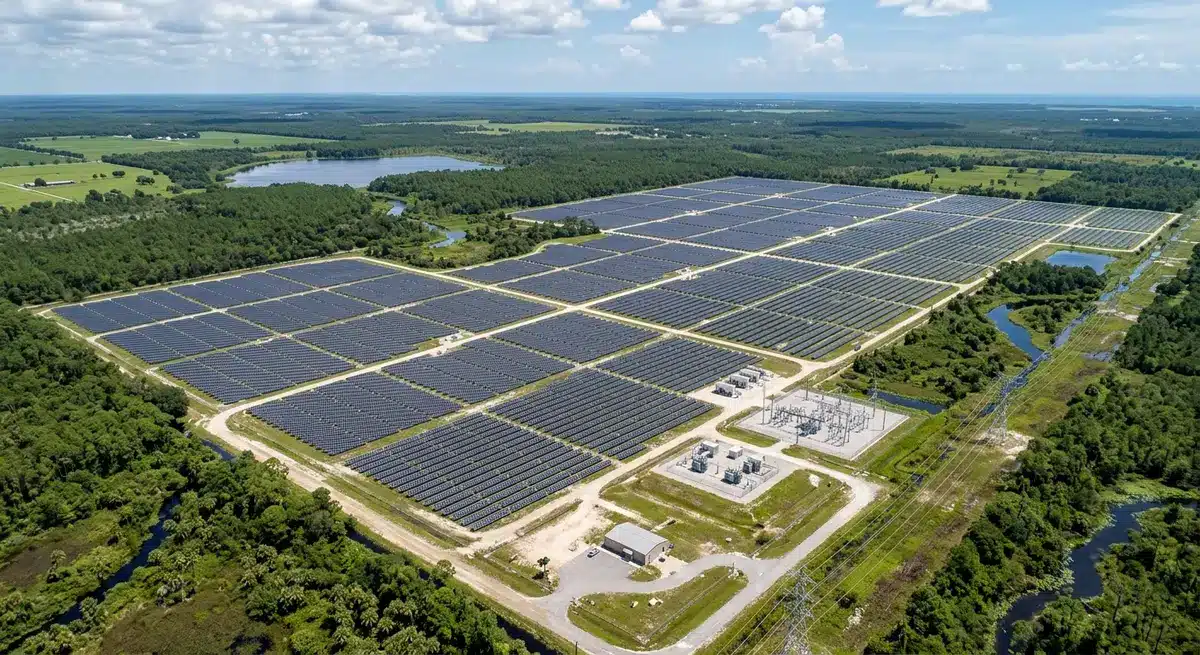
Community solar democratizes this process. The utility company constructs massive solar energy centers—often spanning hundreds of acres and containing hundreds of thousands of bifacial solar panels. These facilities feed clean electricity directly into the broader power grid. Customers then “subscribe” to a portion of this generation capacity. According to the U.S. Department of Energy, community solar programs are critical for the 50% of American households that cannot host rooftop solar systems due to shading, roof conditions, or renting status.
By 2026, the program has expanded to encompass over 40 active solar energy centers across the state, generating thousands of megawatts of zero-emissions electricity. This centralized approach leverages economies of scale. Utility-scale solar costs roughly $0.80 to $1.00 per watt to install, compared to the $2.50 to $3.50 per watt typically seen in residential rooftop systems. These savings are ultimately passed down to the subscriber through the credit system, making model for solar-powered living highly accessible to the average consumer.
Step-by-Step: Enrolling and Earning Credits
The financial architecture of the program is designed to be transparent and consumer-friendly. The Florida Public Service Commission (FPSC) heavily regulates the tariff structures to ensure that the projected payback periods are accurate and fair to ratepayers. Here is the exact step-by-step process of how participation works:
- Capacity Allocation: When a customer enrolls, the utility analyzes their previous 12 months of energy usage. The customer is then allocated a subscription size (in kilowatts) that represents up to 100% of their average annual consumption.
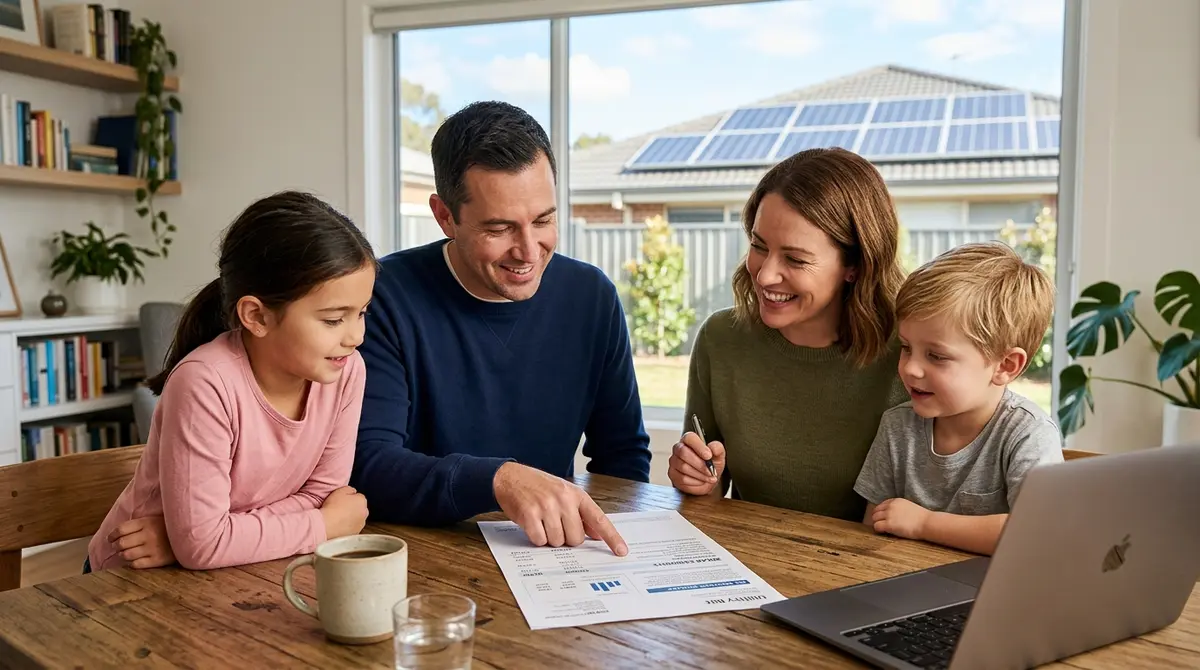
- The Subscription Charge: Each month, a fixed “SolarTogether Charge” appears on the customer’s bill. This fee is calculated based on the number of kilowatts subscribed to. As of 2026, the rate remains locked in at the time of enrollment, shielding the subscriber from future rate hikes associated with fossil fuel volatility.
- The Solar Credit: Alongside the charge, a “SolarTogether Credit” is applied to the bill. This credit is tied to the actual energy produced by the subscriber’s share of the solar centers. Because solar generation fluctuates slightly with the seasons, the credit varies month-to-month.
- The Break-Even Point: During the first few years of enrollment, the subscription charge is slightly higher than the solar credit, resulting in a nominal net cost (often just a few dollars a month). However, the credit rate is designed to escalate annually. Typically, by year three or four, the monthly credit overtakes the monthly charge.
- Long-Term Profitability: From the break-even point onward, the subscriber experiences a net reduction in their monthly utility bill. Over the 20-year lifespan of the subscription, customers are projected to save hundreds, if not thousands, of dollars.
As Marcus Thorne, a senior energy economist at the Florida Solar Research Institute, explains: “The genius of the subscription model lies in its risk mitigation. The utility absorbs the hardware depreciation and maintenance costs, while the consumer locks in a predictable credit yield that outpaces inflation over a 20-year horizon.”
Financial Breakdown: Costs, Credits, and Long-Term Savings
Understanding the exact financial implications requires a look at the data. The program is structured so that the payback period is guaranteed, assuming the customer remains enrolled and stays within the utility’s service territory. If a customer moves to another home within the service area, their subscription moves with them, ensuring uninterrupted credit accumulation.
To illustrate the value proposition, consider the differences between subscribing to a community program versus purchasing a private system. Research from the Solar Energy Industries Association (SEIA) highlights that while rooftop solar offers higher total lifetime savings, community solar offers a dramatically lower barrier to entry and zero maintenance liability.
| Feature | FPL SolarTogether | Traditional Rooftop Solar |
|---|---|---|
| Upfront Cost | $0 (No installation fees) | $15,000 – $30,000+ |
| Maintenance | Handled by utility | Homeowner responsibility |
| HOA Restrictions | None (No physical panels) | Subject to architectural review |
| Portability | Transfers to new address in territory | Fixed to the property |
| Payback Period | 3 to 5 years | 7 to 12 years |
For individuals transitioning to solar living, this financial model is highly attractive. It allows them to support green energy initiatives immediately without waiting for a decade to see a return on investment. Furthermore, the program includes a specific carve-out for low-income households. The low-income iteration of the program waives the initial net-cost period entirely, ensuring that vulnerable populations see immediate bill reductions from month one.
Environmental Impact and Grid Resilience
Beyond individual financial savings, the broader impact of utility-scale solar on Florida’s energy grid is profound. The state’s unique geography makes it highly susceptible to severe weather, necessitating robust infrastructure. The solar energy centers powering this program are engineered to withstand Category 4 and Category 5 hurricane winds, utilizing advanced tracking systems that stow panels in a defensive posture during extreme weather events.
As Dr. Elena Rostova, Lead Grid Analyst at the National Renewable Energy Laboratory (NREL), notes: “By centralizing generation assets, utilities not only improve photovoltaic efficiency by up to 22% compared to distributed rooftop systems, but they also harden the grid against extreme weather events. These solar centers provide a decentralized buffer that aids in rapid post-storm recovery.”
This resilience is a key factor for residents living in a resilient, hurricane-proof city infrastructure. When the grid is supported by diverse, hardened renewable sources, the likelihood of prolonged, widespread outages diminishes. Furthermore, the environmental metrics are staggering. By 2026, the program has offset millions of tons of carbon dioxide emissions, equivalent to removing hundreds of thousands of gasoline-powered vehicles from Florida’s highways annually. The integration of local solar energy centers directly into the community fabric represents a paradigm shift in how municipalities approach sustainability.
Why Master-Planned Communities Embrace Utility-Scale Solar
The success of community solar programs has heavily influenced real estate development across the Sun Belt. Modern master-planned communities are increasingly marketing themselves not just on amenities like golf courses or clubhouses, but on their energy independence and sustainability metrics. Buyers are actively seeking out neighborhoods that align with their environmental values without compromising on modern conveniences.
When examining the experiences of buyers with solar energy, a clear trend emerges: convenience is paramount. Homeowners appreciate the “set it and forget it” nature of a subscription model. They do not have to worry about cleaning panels, replacing inverters, or dealing with roof leaks caused by improper installations. The utility handles all operational logistics.
This seamless integration is a cornerstone of solar-powered community living. It allows entire towns to boast a net-zero or highly renewable energy footprint while keeping housing costs accessible. The synergy between forward-thinking real estate developers and progressive utility programs demonstrates how ownership shapes life in a solar town, prioritizing long-term ecological health alongside economic growth.

Common Misconceptions About the Program
Despite its popularity, several misconceptions persist regarding how community solar subscriptions function. Addressing these myths is crucial for consumers looking to make informed energy decisions in 2026.
- Myth 1: “My power will go out when the sun goes down.”
Reality: Subscribers remain fully connected to the standard electrical grid. The solar centers feed power into the grid during the day, and the utility balances the load using other energy sources (like natural gas or battery storage) at night. Your home’s power supply is uninterrupted. - Myth 2: “I am buying the actual solar panels.”
Reality: You are not purchasing hardware. You are purchasing a subscription to the energy generated by the hardware. The utility retains ownership and maintenance responsibilities for all physical equipment. - Myth 3: “If I cancel, I lose all my money.”
Reality: The program is completely voluntary and operates without cancellation fees. If a subscriber chooses to leave the program, they simply stop paying the subscription charge and stop receiving the credits. There are no long-term binding penalties. - Myth 4: “It is a scam because it costs money upfront.”
Reality: While the first few years do result in a minor net cost (the charge is slightly higher than the credit), this is a heavily regulated tariff approved by the state government. The mathematical models guarantee that the escalating credits will eventually surpass the static charges, resulting in net savings.
Frequently Asked Questions (FAQ)
Who is eligible to join the community solar program?
Any active residential or commercial customer living within the utility’s service territory is eligible to enroll. This includes renters, condo owners, and single-family homeowners, provided their account is in good standing.
How is my subscription size determined?
The utility calculates your subscription size based on your historical energy usage over the past 12 months. You can choose to subscribe to an amount that covers up to 100% of your average annual kilowatt-hour consumption.
What happens to my subscription if I move?
If you move to a new residence that is still within the same utility service territory, your subscription and accumulated credit history transfer seamlessly to your new account. If you move out of the territory, your subscription is simply canceled without penalty.
Are the solar credits taxable income?
No. The solar credits are treated as a reduction in your utility expense, not as taxable income. They simply lower the total amount you owe on your monthly electricity bill.
Can I have rooftop solar and still participate?
Yes, customers who already have rooftop solar arrays can participate in the program to offset any remaining energy consumption that their private panels do not cover, up to their total historical usage limit.
How does weather affect my monthly credits?
Because solar generation relies on sunlight, your credits will fluctuate slightly based on weather patterns and seasonal changes (e.g., longer days in summer yield higher credits). However, the long-term financial models account for these standard weather variations.
Conclusion
Understanding the intricacies of community solar is vital for any Florida resident looking to reduce their environmental impact while securing long-term financial savings. By leveraging a subscription-based model, the program eliminates the high barriers to entry traditionally associated with renewable energy. Participants benefit from zero upfront costs, zero maintenance, and a guaranteed path to net savings, all while supporting the expansion of resilient, utility-scale solar infrastructure across the state. As we move further into 2026, initiatives like this prove that sustainable living and economic pragmatism can go hand in hand.
If you are exploring sustainable real estate options or want to learn more about living in a community that prioritizes renewable energy and resilience, we are here to help you navigate the market. Contact us today to speak with our experts and find the perfect forward-thinking neighborhood for your family.