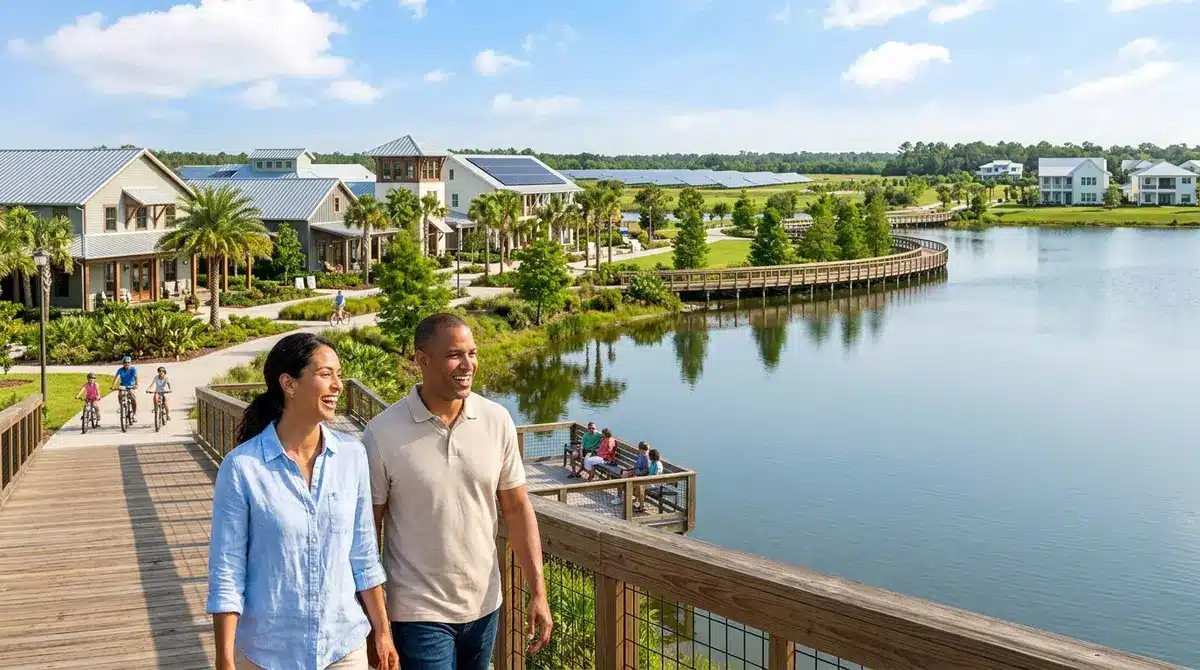

When Hurricane Ian made landfall on September 28, 2022, with winds topping 150 mph, it delivered one of the costliest and most destructive storms in American history. Fort Myers flooded. Sanibel Island was severed from the mainland. Cape Coral lost power for weeks. Nearly 2.7 million Florida customers went dark. Homes were destroyed. Lives were upended. And yet, sitting 30 miles inland in Charlotte County, one community never lost power, never flooded, and opened its doors to over 1,300 hurricane evacuees the morning after the storm passed. That community was Babcock Ranch — and its performance during Ian sparked a nationwide conversation about whether a genuine hurricane proof city in Florida was not just possible, but already real.
The answer, supported by engineering data, FEMA case studies, and real-world storm performance through both Ian and Milton, is a qualified but compelling yes. No community can guarantee zero damage from a direct major hurricane strike. Three independent building experts told Business Insider that “no home can be hurricane-proof.” But the engineering, infrastructure, and design decisions that Babcock Ranch’s developers made — many of them a decade before Ian ever formed — created something so far ahead of conventional Florida development that its storm record stands largely without comparison.
Key Takeaways
- Babcock Ranch sits 30 feet above sea level and 20–30 miles inland, placing it well beyond coastal storm surge reach
- All power, water, and fiber-optic lines are buried underground, eliminating the primary cause of post-storm outages
- Homes are built 1 foot above the flood elevation of a combined 25-year plus 100-year rain event — roughly 25 inches of rain
- The 150-megawatt solar microgrid with 10-megawatt battery storage kept the community fully powered through both Hurricane Ian and Hurricane Milton
- Babcock Ranch serves as an official FEMA case study for storm-resilient community design
- Homeowner insurance premiums at Babcock Ranch average just $1,300–$1,475 annually — a fraction of what coastal Florida neighbors pay
What “Hurricane Proof City in Florida” Really Means

Before going further, it’s worth being precise about language — because precision matters when you’re making a real estate decision based in part on storm safety. No city, neighborhood, or home is fully hurricane-proof. Nature can always exceed human engineering on a bad enough day. What we mean when we call Babcock Ranch the closest thing to a hurricane proof city in Florida is this: the community was designed from the ground up specifically to minimize storm damage, retain power, prevent flooding, and remain functional as a safe haven during and after catastrophic weather events.
That design philosophy is documented by the American Society of Civil Engineers (ASCE), cited as a model by FEMA, and validated twice — once by Ian in 2022 and again by Hurricane Milton in 2024. Each time, the community performed as engineered. Other Florida communities that have since attempted to build storm resilience into their infrastructure — including Hunters Point in Cortez and Las Olas Isles near Fort Lauderdale — point to Babcock Ranch as either an inspiration or a benchmark. The real estate implications of this track record are significant and lasting.
For buyers who are evaluating where in Southwest Florida to put down roots, the concept of a hurricane proof city in Florida is no longer theoretical. It is addressable, specific, and priced in the market today. Our overview of Babcock Ranch community features provides a full foundation for understanding what makes this community structurally different from conventional development.
The Engineering Behind the Resilience

Elevation: The First and Most Critical Line of Defense
Florida’s most catastrophic hurricane damage comes from storm surge — the wall of ocean water that a major storm pushes inland. During Hurricane Ian, storm surge reached 18 feet in parts of Fort Myers and Sanibel. That is the height of a two-story building, pushing seawater through neighborhoods, destroying everything at ground level, and leaving behind toxic mold, structural failures, and uninsurable losses.
Babcock Ranch was built at elevations ranging from 12 to 38 feet above sea level, with the residential and commercial core sitting at approximately 30 feet. That elevation alone placed the community far beyond any realistic storm surge scenario from a Gulf Coast storm. But the developers went further. They extracted 2.5 million cubic yards of fill dirt from preexisting lakes on the property and used it to raise the developed areas an additional 3 to 6 feet above grade — without importing a single truckload of material from outside the property. Every ounce of elevation improvement came from within the community’s own footprint.
Homes are set 5 feet above grade, exceeding FEMA’s base elevation requirements. Local roads are raised 3.5 feet for runoff control, while major roads are elevated 4.5 feet to remain navigable for emergency vehicles during and after storms. Grocery stores and community offices are elevated 6+ feet to stay operational when residents need them most.
For buyers from inland states or coastal markets, these numbers may seem technical. In practice, they mean one thing: at Babcock Ranch, the chance of your home flooding from hurricane rainfall or surge is dramatically lower than anywhere else in Southwest Florida’s real estate market. Our dedicated post on flooding and natural disaster concerns at Babcock Ranch breaks down these engineering standards in accessible detail. You can also review relevant FEMA flood zone maps and standards at the FEMA National Flood Insurance Program portal for context on how those standards apply to home purchases in Florida.
Underground Infrastructure: Eliminating the Weakest Link
The single most common cause of post-hurricane power outages in Florida is not the wind itself — it is wooden utility poles snapping, power lines falling, and transformers failing when struck by debris. Babcock Ranch eliminated that vulnerability entirely. Every electrical, data, and water line is buried underground throughout the entire community. You will not find a single wooden telephone pole within any residential area.
The American Society of Civil Engineers noted this as a defining feature of Babcock Ranch’s resilience design — one that directly enabled the community to maintain power when Ian knocked out electricity for the surrounding region. During both Ian and Milton, no downed power lines, no pole failures, and no grid disruptions occurred because there were no poles to fail. Developer Syd Kitson said simply: “We were basically the only place in southwest Florida that had power, and it’s because we had spent so much time working with FPL to harden the infrastructure.”
The fiber-optic internet network — providing 1 gigabit per second to every home and business — is equally buried and protected. When other Southwest Florida communities were dealing with connectivity outages for weeks after Ian, Babcock Ranch residents had uninterrupted internet access. For remote workers, business owners, and anyone who depends on connectivity in their daily life, this is not a minor amenity. It is a material quality-of-life advantage that few communities in the nation can match.
For specifics on FPL’s underground grid infrastructure and community resilience investments, visit Florida Power & Light’s storm resilience page.
The Solar Microgrid and Battery Storage System
Babcock Ranch’s 150-megawatt solar array — 870 acres of approximately 700,000 panels operated by Florida Power & Light — generates enough clean electricity to power the entire community and then some. But raw solar generation isn’t enough for storm resilience; the sun doesn’t always shine during and immediately after major weather events. That’s where the battery storage component becomes critical.
The community includes ten large battery storage units with a combined 10-megawatt capacity, providing a buffer that keeps electricity flowing during periods when solar generation is reduced. This solar-plus-storage configuration — designed to withstand a Category 5 hurricane, with the solar infrastructure built on concrete utility poles rather than traditional wooden ones — kept Babcock Ranch fully powered through Ian’s peak 150+ mph winds and through Milton the following year.
For buyers who have lived through Florida hurricane seasons and know what it means to lose power for days or weeks, this infrastructure is one of the most tangible reasons Babcock Ranch homes for sale command a premium over comparable communities. It also contributes to dramatically lower homeowner insurance costs — another line item that adds up significantly over the life of a mortgage.
The “Bowl” Lake Water Management System
Flooding at Babcock Ranch is managed through a system that FEMA has documented as a case study in effective stormwater engineering. The community uses a series of interconnected artificial lakes positioned strategically lower than homes and roads, connected by underground pipes that shift overflow between basins as storm conditions develop. This is what engineers call a “bowl” design — water follows gravity into the lakes rather than into living spaces.
Before major storms, community managers can pre-drain the lakes to create additional storage capacity for incoming rainfall. The system is designed to handle the equivalent of a 25-year storm event followed immediately by a 100-year storm event — approximately 25 inches of total rainfall in sequence — without flooding homes. All stormwater structures include a 2-foot sump space to capture sediment, allowing it to be removed before it clogs pipes and compromises flow capacity.
Native vegetation and expanded wetlands throughout the community’s preserved green spaces — which cover over 50% of Babcock Ranch’s footprint — further absorb and slow stormwater runoff. This isn’t just an engineering solution; it’s an ecological one. The same wetlands that protect homes from flooding also support wildlife habitat, improve air quality, and give the community its distinctive natural character. The Charlotte County Government’s stormwater management resources provide additional context on how these systems interact with county-level drainage infrastructure.
Hurricane Ian and Hurricane Milton: Two Real-World Tests
Hurricane Ian, September 2022
Category 4 at landfall. Winds of 150+ mph. Storm surge of up to 18 feet in Fort Myers. Over 2.7 million customers without power across Florida — some for weeks. Babcock Ranch: zero power outages, zero flooded homes, zero structural failures.
The morning after the storm, the Babcock Neighborhood School’s fieldhouse — built to withstand 150 mph winds and serving as a state- and county-designated evacuation center — was providing shelter to evacuees from Sanibel Island, Fort Myers, and other devastated communities nearby. The shelter served 1,300 displaced Floridians, all powered by the community’s solar microgrid.
The BBC reported that developer Syd Kitson called the moment he learned the community had made it through Ian “emotional” — the realization that years of design decisions, cost overruns, and engineering choices made against conventional developer wisdom had paid off on the worst possible night they could be tested.
Hurricane Milton, October 2024
Two years later, Hurricane Milton made landfall near Sarasota, delivering another severe test across Southwest Florida. Babcock Ranch again maintained 100% power uptime and reported only minor cosmetic damage — some downed traffic lights and fallen trees. The Daily Mail reported that in the days before Milton’s arrival, Babcock Ranch’s website saw a 390% increase in daily visits as Floridians searched for safer communities to relocate to.
That surge in interest is direct market evidence of how storm resilience affects real estate demand. When people are scared, when they’re weighing the cost of another hurricane season, they search for answers. Babcock Ranch’s back-to-back performance through Ian and Milton has made it one of the first communities Florida buyers research when storm safety is a priority.
Our dedicated blog post on Babcock Ranch’s hurricane-proof design and storm performance provides a detailed timeline of both events and the community’s documented response.
What Storm Resilience Means for Your Real Estate Investment
Insurance Savings That Compound Over Time
Florida’s homeowners insurance crisis is real and documented. Coastal communities face premiums that have tripled or quadrupled in recent years as insurers withdraw from the market or price risk at levels many homeowners cannot sustain. In communities like Fort Myers Beach and Sanibel, post-Ian premiums for rebuilt homes routinely exceed $15,000–$25,000 per year — if coverage can be obtained at all.
At Babcock Ranch, homeowners report 2026 annual insurance premiums of just $1,300–$1,475 for comparable homes. That is not a rounding error. Over a 30-year mortgage, the difference between a $1,400 annual premium and a $12,000 annual premium compounds to over $300,000 in savings — money that buys a great deal of lifestyle, education, or retirement security. For buyers who are comparing Babcock Ranch to other Southwest Florida communities, insurance cost is one of the most important financial factors to incorporate into total cost of ownership analysis.
Our Babcock Ranch housing market trends analysis incorporates insurance and HOA cost context into its pricing framework, giving you a complete financial picture before you make an offer.
Property Values With Structural Upside
When a hurricane proof city in Florida demonstrates its credentials through actual storms, property values respond. Babcock Ranch ranked 4th nationally among all master-planned communities for home sales in 2025, with a record 1,066 net sales — its first time surpassing 1,000 net sales in a calendar year, and a 34% increase from the prior year. The median home price across the community sits at approximately $493,812, higher than 59.9% of Florida neighborhoods.
That pricing reflects more than solar energy and event culture. It reflects a buyer pool that increasingly understands what investment potential in Babcock Ranch is worth — and a community that has proven it twice against storms that devastated everything around it. Buyers who entered Babcock Ranch before Ian had excellent timing. Buyers who enter now are still purchasing into a community with substantial growth ahead — 20,000 planned homes and a projected 60,000 residents at full build-out.
Why You Need a Local Agent to Capitalize on This Market
Babcock Ranch’s storm resilience story is compelling enough to draw buyers from across the country. But arriving at the community’s website or a national listing portal and picking a home based on hurricane proof credentials alone is a significant mistake. Not all neighborhoods within the 18,000-acre community are equally positioned relative to the lake system, the elevation grades, the solar infrastructure access, or the community amenities that make daily life here genuinely satisfying.
Our team knows which floor plans in which neighborhoods represent the best value relative to storm protection, insurance cost, resale trajectory, and lifestyle fit. We have walked these communities, tracked their pricing through market cycles, and helped buyers avoid costly mismatches between their expectations and what a floor plan actually delivers. Without that local expertise, you’re making one of the largest financial decisions of your life based on marketing materials and satellite imagery. That’s not a sound foundation.
For sellers, the hurricane resilience story is a genuine premium to market — but only if it’s positioned correctly in your listing against the right buyer profiles. Our team understands how to communicate the engineering specifics, the insurance savings, and the community track record in ways that move serious buyers to offers. Read our guide to Babcock Ranch community development updates for current context on how the market is moving across neighborhoods. For broader Florida market comparisons, Florida Realtors’ storm resilience and property value research provides useful regional context.
Connect With Our Team
If the idea of living in something close to a hurricane proof city in Florida resonates with you — whether you’ve lived through a Florida storm or are relocating from another state and want to make a smarter choice from the start — we are ready to help you move forward with confidence. What Are the Experiences of Buyers Who Went Through the Purchasing Process in Babcock Ranch? specializes in this community and brings real local knowledge to every transaction. Call us directly at 518-569-7173 or email andrelafountain@gmail.com to schedule a consultation or a community tour. We’ll answer your questions, show you the neighborhoods that fit your life and budget, and give you the honest data-backed guidance that makes the difference between a good purchase and a great one.
Let What Are the Experiences of Buyers Who Went Through the Purchasing Process in Babcock Ranch? help you find your place in the most storm-resilient, solar-powered community in the state — the hurricane proof city in Florida that has already been put to the test and passed.
Common Questions About Hurricane Proof City in Florida
Q: Is Babcock Ranch truly a hurricane proof city in Florida?
A: No community is 100% hurricane-proof — experts consistently note that nature can exceed any engineering. However, Babcock Ranch is the most storm-resilient planned community in Florida, having maintained full power with no flooded homes through both Hurricane Ian (2022) and Hurricane Milton (2024). FEMA cites it as an official storm resilience case study.
Q: Why didn’t Babcock Ranch lose power during Hurricane Ian?
A: All electrical, data, and water lines at Babcock Ranch are buried underground, eliminating the downed-pole failures that cause most Florida outages. Combined with a 150-megawatt solar array and 10-megawatt battery storage system, the community maintained full electricity throughout Ian’s 150+ mph winds while 2.7 million surrounding customers lost power.
Q: How high above sea level is Babcock Ranch?
A: Babcock Ranch sits at elevations ranging from 12 to 38 feet above sea level, with the residential core at approximately 30 feet. This places it far beyond the reach of Gulf Coast storm surge. Homes are further set 5 feet above local grade, exceeding FEMA new construction elevation standards, and were built on fill dirt raised an additional 3–6 feet during construction.
Q: How does Babcock Ranch prevent flooding during heavy rain?
A: The community uses a “bowl” lake system where interconnected artificial lakes sit lower than homes and roads, collecting runoff via underground pipes. Lakes can be pre-drained before storms to add capacity. The system is engineered to handle approximately 25 inches of sequential rainfall — equivalent to a 25-year storm followed by a 100-year event — without flooding homes.
Q: How much are homeowner insurance premiums at Babcock Ranch?
A: Babcock Ranch homeowners report 2026 annual insurance premiums of approximately $1,300–$1,475 — dramatically lower than coastal Florida communities where equivalent homes can cost $10,000–$25,000+ per year to insure. Over a 30-year mortgage, this difference represents hundreds of thousands of dollars in savings.
Q: How did Babcock Ranch help Hurricane Ian evacuees?
A: The Babcock Neighborhood School’s fieldhouse — rated to withstand 150 mph winds and designated as an official state and county evacuation center — sheltered 1,300 displaced residents from Fort Myers, Sanibel, and surrounding communities. The shelter operated entirely on the community’s solar microgrid throughout the storm and recovery period.
Q: Did Babcock Ranch survive Hurricane Milton as well?
A: Yes. In October 2024, Hurricane Milton delivered another direct test, and Babcock Ranch again maintained 100% power uptime with only minor cosmetic damage — some downed traffic lights and fallen trees. In the days before Milton’s landfall, Babcock Ranch’s website saw a 390% increase in daily traffic as Florida residents searched for safer communities.
Q: What building code standards do Babcock Ranch homes meet?
A: All Babcock Ranch homes are built to or beyond Florida’s stringent hurricane-resistant building codes, featuring impact-resistant windows, reinforced roofing, and elevated foundations. Buildings are engineered to withstand winds exceeding 150 mph. Minimum floor elevations are set 1 foot above the flood level of a combined 25-year plus 100-year rain event.
Q: How does Babcock Ranch compare to other storm-resilient Florida communities?
A: Babcock Ranch is the largest and most comprehensively resilient storm-resistant community in Florida. Comparable efforts include Hunters Point (86 homes, Cortez), which has survived four major hurricanes, and Las Olas Isles (underground utilities only). Building experts cite Babcock Ranch and Hunters Point as the clearest national examples of what community-scale hurricane resilience looks like in practice.
Q: Should I work with a real estate agent when buying in a storm-resilient community like Babcock Ranch?
A: Absolutely. Babcock Ranch’s engineering advantages are real, but not every home or neighborhood within the community is positioned equally relative to the lake system, elevation grades, and insurance implications. A buyer’s agent with specific Babcock Ranch expertise helps you identify the right fit — and protects you from overpaying or underestimating total cost of ownership in a complex, fast-growing market.