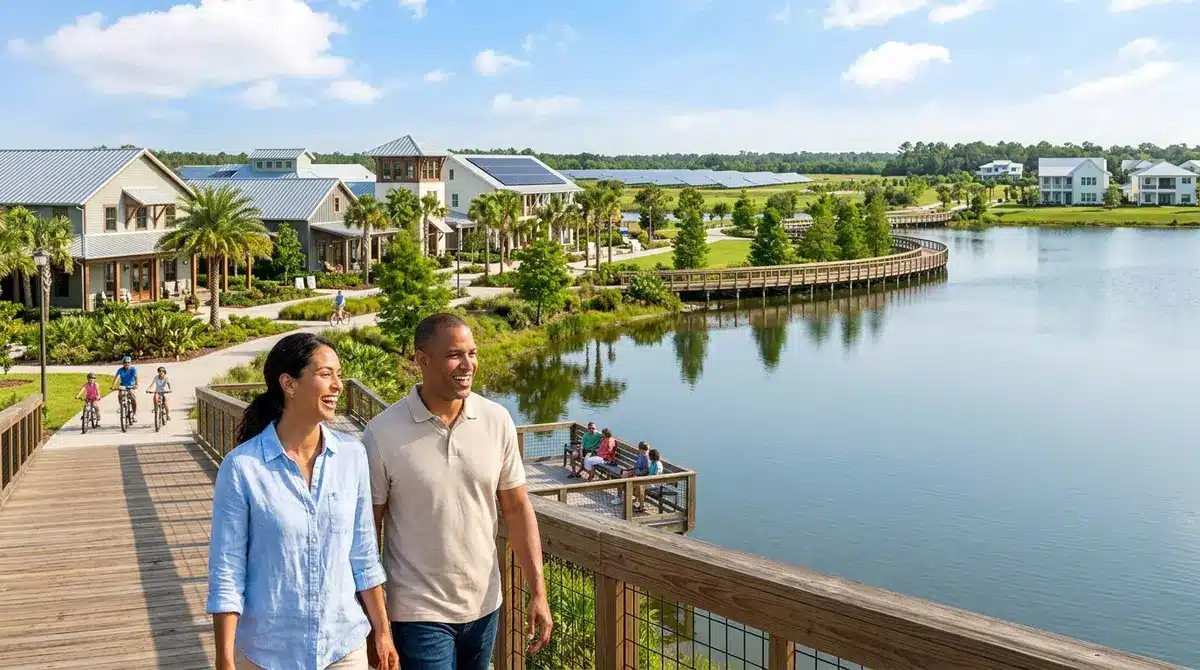
Evaluating the advantages and drawbacks of relocating to Florida’s premier sustainable town requires looking beyond the marketing brochures. The primary benefits include unparalleled hurricane resilience, stable solar-powered utilities, and a highly walkable, self-contained community design. Conversely, the main disadvantages involve the distance from major coastal beaches, mandatory Community Development District (CDD) fees, and the noise associated with ongoing residential construction in 2026.
Key Takeaways
- 100% Solar-Powered Infrastructure: The local microgrid ensures power stability and lower environmental impact.
- Proven Storm Resilience: Underground utilities and native landscaping provide documented Category 4 hurricane protection.
- Self-Contained Lifestyle: On-site schools, grocery stores, and medical facilities reduce the need for daily commuting.
- Geographic Location: The inland location means a 45-to-60-minute drive to popular Gulf Coast beaches.
- Additional Costs: Buyers must factor in CDD and HOA fees on top of standard property taxes.
- Active Development: Ongoing expansion means living near active construction zones through the late 2020s.
The Vision Behind America’s First Solar-Powered Town
To truly understand the benefits and drawbacks of this unique master-planned community, one must first look at the vision of its founder, Syd Kitson. The goal was never just to build another suburban sprawl in Southwest Florida; it was to create a blueprint for the future of sustainable living. By prioritizing environmental preservation and smart growth, the developers set aside half of the original 18,000-acre footprint for nature reserves and wetlands.
“Babcock Ranch represents the pinnacle of climate-resilient urban planning,” explains Dr. Sarah Jenkins, a structural resilience researcher. “By integrating natural water flow systems with advanced microgrid technology, the developers have created a template that other coastal states are now rushing to replicate.”
Today, in 2026, the town stands as a testament to that original vision, boasting a population that continues to grow as buyers prioritize safety and sustainability over traditional coastal proximity.
Major Advantages of the Solar City Lifestyle
Unmatched Hurricane Resilience and Safety
Perhaps the most significant advantage of living here is the storm-resilient infrastructure. When Hurricane Ian struck in 2022, and subsequent storms tested the region through 2025, this community famously never lost power. The secret lies in a multi-layered approach to disaster preparedness.
All power lines are buried underground, protecting them from the 150 mph winds that frequently devastate above-ground grids. Furthermore, the town’s elevation is naturally higher than the surrounding coastal areas, sitting approximately 30 feet above sea level. According to the Federal Emergency Management Agency (FEMA), strategic wetland preservation and elevated grading can reduce catastrophic flood risks by up to 40%. The community utilizes a massive network of attenuation ponds and restored flow ways that naturally redirect storm surges away from residential streets.
Sustainable Energy and Lower Utility Costs
The backbone of the town is its massive solar energy center. Spanning 870 acres, the facility utilizes over 680,000 photovoltaic panels to generate more clean energy than the town consumes. During the day, the community runs entirely on solar power, with battery storage systems kicking in during the evening or overcast days.
Research from the U.S. Department of Energy highlights that community microgrids significantly reduce transmission losses and provide critical energy security during regional grid failures. For residents, this translates to highly stable utility bills and the peace of mind that comes from knowing their carbon footprint is drastically reduced.
A Thriving, Self-Contained Community
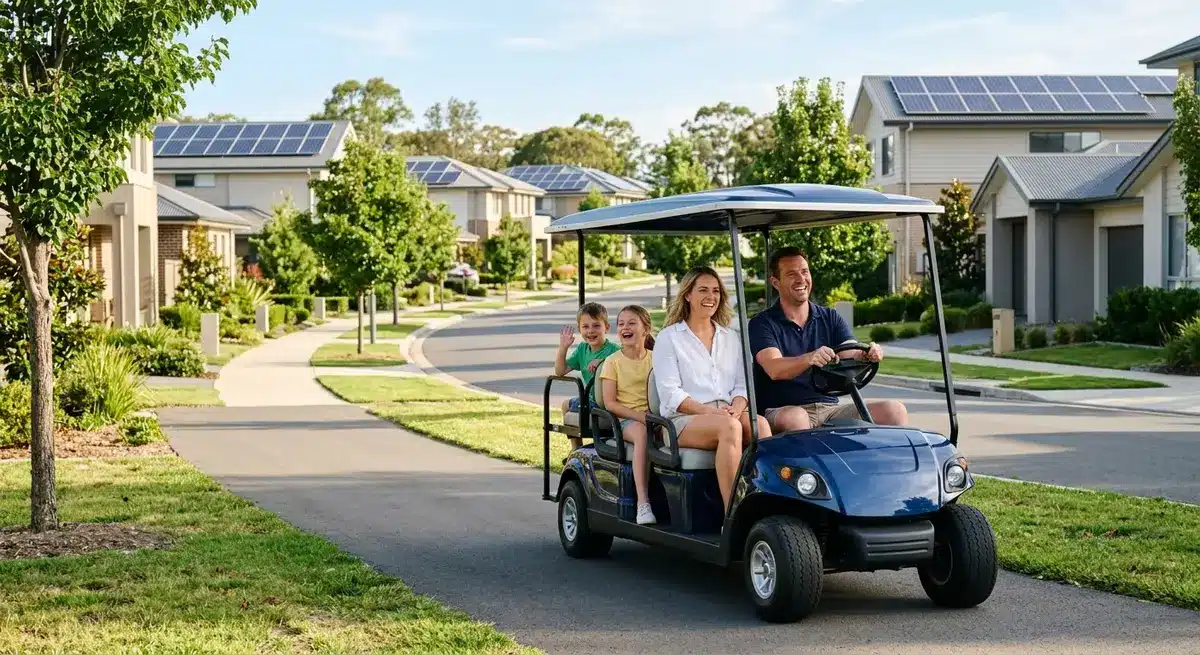
The urban design prioritizes walkability and micro-mobility. Residents frequently use golf carts, bicycles, or walking trails to navigate between neighborhoods and commercial centers. The addition of essential amenities, such as on-site medical centers, top-rated charter schools, and retail plazas, means you rarely have to leave the town limits for daily necessities.
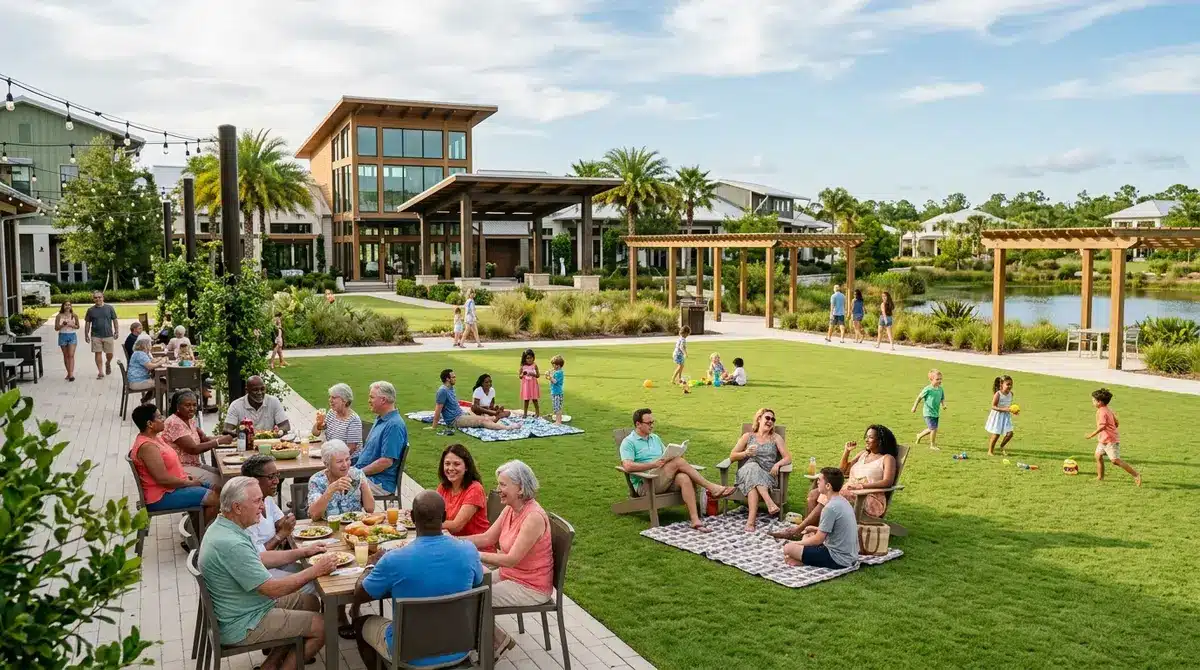
The local grocery store has become a central hub for the community, making golf cart grocery runs a staple of the local lifestyle. This self-contained ecosystem fosters a strong sense of community, with weekly farmers markets, food truck nights, and live music events at Founder’s Square bringing neighbors together.
The Drawbacks: What to Consider Before Buying
Distance from Beaches and Urban Centers
While the inland location provides crucial protection from storm surges, it also presents one of the primary disadvantages for those seeking a traditional Florida lifestyle. The distance to the coast is a frequent point of contention for new buyers.
Located in Charlotte County, just north of Lee County, the town is approximately 30 to 40 miles away from the popular beaches of Fort Myers, Sanibel Island, and Naples. Depending on seasonal traffic, a trip to the beach can take anywhere from 45 minutes to over an hour. For retirees or families who envisioned daily sunset walks on the sand, this geographic reality requires a significant lifestyle adjustment.
Community Development District (CDD) and HOA Fees
Financial considerations are paramount when evaluating the financial case for sustainability. Beyond standard property taxes, residents are subject to Community Development District (CDD) assessments and Homeowners Association (HOA) fees.
A Community Development District, as defined by Wikipedia, is a local, special-purpose government framework used to finance and manage infrastructure. In this town, the CDD pays for the extensive water management systems, parks, and underground utilities. Depending on the lot size and neighborhood, CDD fees can add $1,500 to $3,000 annually to a homeowner’s tax bill. When combined with HOA fees that cover internet, lawn maintenance, and community amenities, the monthly carrying costs can be higher than in non-master-planned neighborhoods.
Ongoing Construction and Growing Pains
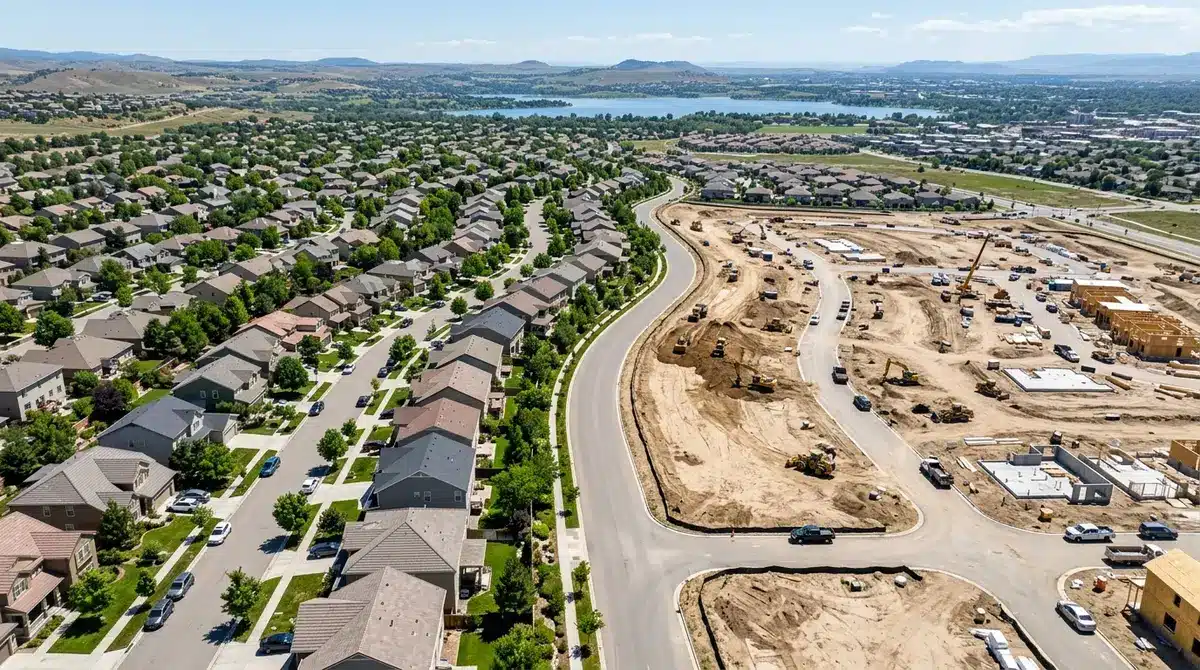
As of 2026, the town is still in a phase of aggressive expansion. The rapidly expanding population brings both economic vitality and growing pains. If you purchase property in one of the newer subdivisions, you will likely be living in an active construction zone for several years.
This means dealing with heavy machinery traffic, construction dust, and the noise of framing and roofing starting early in the morning. Additionally, while commercial amenities are expanding, some residents feel that dining and nightlife options are still too limited, forcing them to drive into Fort Myers or Punta Gorda for a wider variety of entertainment.
Comparing the Lifestyle: A Quick Reference Table
To help visualize the trade-offs, here is a direct comparison of the primary lifestyle factors:
| Lifestyle Factor | The Advantage | The Drawback |
|---|---|---|
| Weather & Safety | Category 4 hurricane resilience, no power loss history. | Inland location means hotter summer temperatures with less coastal breeze. |
| Location | Surrounded by 73,000 acres of protected nature preserves. | 45+ minute drive to major Gulf Coast beaches and downtown Fort Myers. |
| Cost of Living | Lower utility bills, gigabit internet included in HOA, high energy efficiency. | Mandatory CDD fees and HOA dues increase monthly carrying costs. |
| Community | Highly walkable, golf-cart friendly, excellent on-site schools. | Limited nightlife and dining options; ongoing construction noise. |
How to Evaluate if This Community is Right for You
Making the decision to relocate requires a systematic approach. Follow these steps to determine if the benefits outweigh the drawbacks for your specific situation:
- Assess Your Commute and Travel Needs: Calculate the exact driving distance to your workplace, preferred beaches, and the Southwest Florida International Airport (RSW). If you require daily access to the coast, the inland location may become frustrating.
- Calculate the Total Cost of Ownership: Do not just look at the sticker price of the property. Request a full breakdown of the annual property taxes, CDD assessments, and HOA fees. Compare these numbers against the projected savings on your monthly utility and insurance bills.
- Visit During Different Times of Day: Spend a weekend in the area. Visit Founder’s Square on a busy Friday night, but also drive through the newer neighborhoods on a Tuesday morning to gauge the level of construction noise and traffic.
- Review the Master Plan: Look at the 2026-2030 development phases. Understand what commercial plazas, parks, or residential blocks are planned near your prospective lot. A beautiful preserve view today might become a new subdivision tomorrow.
- Consult with a Local Expert: Speak with real estate professionals who specialize in this specific master-planned community. They can provide historical data on resale values and help you navigate the nuances between different neighborhood builders.
Frequently Asked Questions
Are the CDD fees permanent?
CDD fees typically consist of two parts: an operations and maintenance (O&M) portion, and a bond repayment portion. The bond portion usually has a fixed term (often 30 years) and can sometimes be paid off early, while the O&M portion continues indefinitely to maintain community infrastructure.
Does the solar power completely eliminate electric bills?
No. While the solar facility powers the town’s grid, residents still receive a bill from Florida Power & Light (FPL). However, because the properties are built to strict energy-efficiency standards, monthly electric bills are generally much lower than the state average.
Is the community safe from flooding?
Yes, the town was engineered with extensive water management systems. The streets are designed to act as secondary drainage pathways during extreme rainfall, keeping water away from the elevated residential foundations. According to the National Hurricane Center, inland elevation is one of the strongest predictors of flood safety.
Can I use any builder I want?
No. The community operates with a select group of approved builders who must adhere to the town’s strict architectural and environmental sustainability codes. This ensures uniform quality and compliance with the Florida Green Building Coalition standards.
How is the internet connectivity?
Excellent. The entire town is wired with fiber-optic cables, providing gigabit-speed internet to every residence. This high-speed connectivity is typically included in the monthly HOA fees, making it an ideal location for remote workers.
Are there age-restricted neighborhoods?
Yes. While the majority of the town is multi-generational and family-friendly, there are specific neighborhoods, such as Regency, that are 55+ age-restricted, offering tailored amenities like private clubhouses and resort-style pools for active adults.
Conclusion
Deciding whether to move to America’s first solar-powered town comes down to prioritizing what matters most to your lifestyle. If your primary concerns are environmental sustainability, cutting-edge hurricane resilience, and a tight-knit, walkable community, the advantages here are virtually unmatched in the 2026 Florida real estate market. The peace of mind that comes from knowing your property is engineered to withstand severe weather is a powerful draw.
However, these benefits come with compromises. The inland location requires a longer drive to the Gulf beaches, and the financial structure includes mandatory CDD and HOA fees that must be factored into your long-term budget. Furthermore, as the town continues its rapid growth, residents must be prepared for the realities of living near active development.
If you are ready to weigh these factors and explore the available properties, expert guidance is essential to finding the perfect neighborhood fit. Contact us today to speak with our dedicated team and schedule a personalized tour of the community.