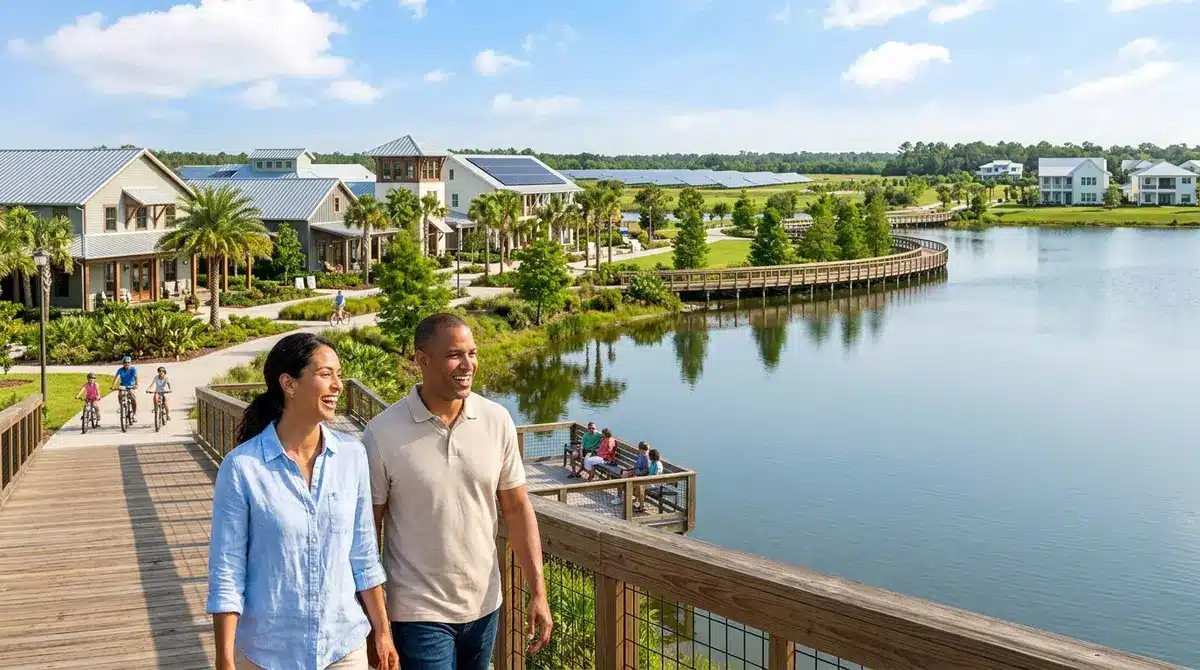

Welcome to the Hometown of Tomorrow. When you drive past the solar trees in Founder’s Square or hike the trails of the preserve, you are walking through a story that began over a century ago. The history of Babcock Ranch is not just a timeline of dates; it is a chronicle of stewardship, vision, and resilience.
For modern homebuyers, understanding this history is essential. It explains why we have 73,000 acres of permanent preservation. It explains why our infrastructure withstood Hurricane Ian when others faltered. And it explains why investing in a home here is an investment in a philosophy that prioritizes the future.
Key Takeaways
- A Century of Stewardship: The land has been actively managed and preserved since Edward Vose Babcock purchased it in 1914.
- The Largest Preservation Deal: The 2006 sale to Kitson & Partners resulted in the largest single land preservation purchase in Florida’s history.
- Energy Independence: The partnership with Florida Power & Light (FPL) to create the first solar-powered town was baked into the master plan from day one.
- Resilient by Design: The community’s performance during recent storms is a direct result of modern engineering built upon a foundation of respect for the natural landscape.
Overview
In this guide, we will take you through the pivotal moments that shaped our community. We will look at the early days of timber and cattle, the transition to state preservation, and the ambitious development plan that created the sustainable real estate market we see today.
If you are considering buying a home here, this context matters. It distinguishes Babcock Ranch from generic subdivisions. We will show you how the decisions made decades ago protect your property value today and why our “nature-first” approach provides a lifestyle you cannot find anywhere else in Southwest Florida.
The Early Days: The Crescent B Ranch

Long before the first solar panel was installed, this land was known as the Crescent B Ranch. The story effectively begins in 1914, when Edward Vose Babcock, a lumber baron and the Mayor of Pittsburgh, purchased the 91,000-acre tract.
At the time, Florida was a frontier. Babcock used the land primarily for timber and agriculture. However, unlike many industrialists of his era who clear-cut and abandoned land, the Babcock family practiced selective harvesting. They understood that the land’s value lay in its long-term health. This early philosophy of “sustainable harvesting” planted the seeds for the sustainable development we enjoy today.
The Fred Babcock Era
After Edward’s passing, his son Fred Babcock took over management. Fred was a true character and a steward of the land. He introduced new agricultural innovations, including ostrich and alligator farming, and famously maintained the ranch as a working operation.
Under his guidance, the ranch remained a pristine wilderness amidst a rapidly developing Florida. While coastal cities were being paved over, the interior of Charlotte and Lee counties remained a haven for black bears, panthers, and native cypress swamps. This dedication effectively saved the ecosystem that now forms the backdrop of neighborhoods like Lake Timber and The Preserve.
The Turning Point: 2006 Acquisition

By the early 2000s, the pressure to develop the ranch was immense. The Babcock family sought a buyer who would honor the land’s legacy rather than chop it into thousands of small parcels. Enter Syd Kitson and Kitson & Partners.
In 2006, Kitson & Partners finalized a landmark agreement. They purchased the entire 91,000-acre ranch but immediately sold roughly 73,000 acres back to the State of Florida and Lee County for permanent preservation. This was the largest preservation buy in state history.
The Vision for the Remaining 18,000 Acres
Kitson retained approximately 18,000 acres with a bold vision: to create the most sustainable, innovative new town in America. The goal was not just to build homes, but to prove that development and conservation could coexist. This vision included:
- Solar Power: A partnership with FPL to build a 75-megawatt solar energy center (now expanded significantly).
- Water Management: Restoring natural flow ways to prevent flooding and filter water.
- Connectivity: Installing gigabit fiber to every home before a single foundation was poured.
Building the Hometown of Tomorrow (2015–Present)
Construction officially began in 2015. The first residents moved in during early 2018, marking the transition from a concept to a living community.
The Solar Commitment
From the start, the history of Babcock Ranch has been tied to energy independence. FPL’s Babcock Ranch Solar Energy Center was groundbreaking. Today, the town generates more clean energy than it consumes. For homeowners, this means living in a community with a net-zero carbon footprint, a major selling point in today’s eco-conscious real estate market.
Resilience in the Face of Storms
The true test of the town’s design came in September 2022 with Hurricane Ian. While surrounding areas suffered catastrophic power outages and flooding, Babcock Ranch never lost power and saw no significant flooding. This was not luck; it was history in action. The elevation levels determined during the planning phase and the hardening of the electrical grid proved that the “Hometown of Tomorrow” was built to last.
How History Shapes Your Real Estate Value
When we help clients buy or sell in Babcock Ranch, we often talk about “legacy value.” You are not just buying a house; you are buying into a protected environment.
- Scarcity: Because 73,000 acres are preserved forever, the development footprint is finite. This creates a natural scarcity that supports long-term property values.
- Amenities: The history of the ranch is preserved in the amenities. The Cypress Lodge, for example, reflects the historic architecture of old Florida, providing a gathering space that feels authentic, not manufactured.
- Community Spirit: The shared knowledge that we are part of a “grand experiment” in sustainability fosters a tight-knit community. Neighbors here are united by a desire for a greener, smarter future.
Experience the Legacy Yourself
What Are the Experiences of Buyers Who Went Through the Purchasing Process in Babcock Ranch?
We are here to help you navigate this unique market. Whether you are looking for a new build in MidTown or a resale in a mature neighborhood, we have the local expertise you need.
Phone: 518-569-7173 Email: andrelafountain@gmail.com
Common Questions About History of Babcock Ranch
Q: Who originally owned the land before it was Babcock Ranch? A: Before Edward Babcock purchased it in 1914, the land was owned by the Perry McAdow family in the late 1800s, who operated it as the “Crescent B Ranch.”
Q: When did Babcock Ranch officially open to residents? A: The first residents, often referred to as “pioneers,” moved into their homes in January 2018, marking the official opening of the residential community.
Q: Is the Babcock Ranch Preserve open to the public? A: Yes. The 73,000-acre preserve is managed by the state and offers opportunities for hiking, hunting, camping, and eco-tours, continuing the legacy of public access to nature.
Q: How did the community get its name? A: It is named after Edward Vose Babcock, the Pittsburgh lumber baron and politician who bought the land in 1914 and established the family’s stewardship over the property.
Q: Was Babcock Ranch affected by Hurricane Ian? A: The community took a direct hit but suffered minimal damage. It famously never lost power, and there was no significant flooding, validating the storm-resilient engineering and higher elevation standards.
Q: Who is the developer of Babcock Ranch? A: The community is developed by Kitson & Partners, led by Syd Kitson, a former NFL player turned real estate developer with a passion for conservation and sustainability.
Q: What was the primary industry on the ranch before development? A: For most of the 20th century, the primary industries were timber (logging), cattle ranching, and agriculture, including sod and vegetable farming.
Q: How much of the original ranch was preserved? A: Approximately 80% of the original purchase, or roughly 73,000 acres, was sold to the State of Florida and Lee County for permanent preservation.
Conclusion
The history of Babcock Ranch is still being written, and by moving here, you become a co-author of its next chapter. From the cattle drives of the 1920s to the solar arrays of the 2020s, this land has always been about looking forward. If you are ready to be part of a community that honors its past while building a resilient future, contact us today.