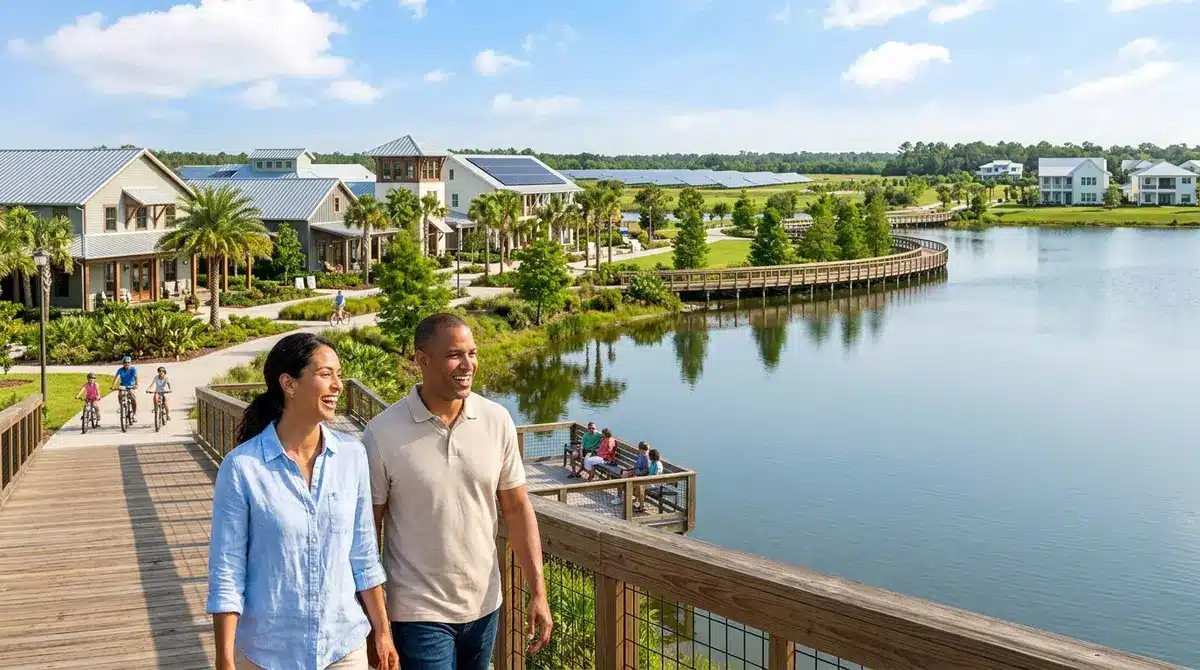

When you drive through the entrance of Babcock Ranch today, past the shimmering solar arrays and into the manicured streets of Founder’s Square, it is easy to see only the “Hometown of Tomorrow.” You see autonomous shuttles, high-speed fiber internet, and state-of-the-art schools. However, to truly understand the value of this land—and why it remained dry while the rest of Southwest Florida flooded during recent hurricanes—you have to look back over a century. The history of Babcock Ranch is not just a timeline of dates; it is a story of deliberate stewardship that directly impacts the safety and value of your potential home today.
Prospective buyers often ask us about the stability of the area. By understanding the deep roots of this community, you gain more than just trivia; you gain the confidence that comes from investing in a place that has been protected, preserved, and planned for generations.
Key Takeaways
- The 100-Year Buffer: The land was purchased in 1914 by Edward Vose Babcock and held as a private reserve for nearly a century, preventing the sporadic, unplanned sprawl seen elsewhere in Florida.
- Conservation First: The 2006 sale to developer Syd Kitson included the largest preservation purchase in Florida history, ensuring that 73,000 acres remain wild forever.
- High Ground Advantage: The ranch was originally used for timber and cattle because of its high elevation (up to 30+ feet), a geographical blessing that keeps modern homes safe from storm surges.
- A Legacy of Innovation: From early 20th-century electrified fences to 21st-century solar fields, this land has always been a testbed for new agricultural and industrial technologies.
- The “Kitson Vision”: The modern era began with a handshake deal that prioritized sustainability over maximum density, resulting in a town where 50% of the footprint is dedicated to greenways and lakes.
Overview: Why the Past Protects Your Future
In this guide, we will journey through the three distinct eras of Babcock Ranch: the Lumber Baron Era, the Stewardship Era, and the modern Solar Era. We will explain how the decisions made by a Pittsburgh mayor in 1914 created the “high and dry” topography that saved the community during Hurricane Ian. We will also explore how the unique partnership between the state and the developer created a neighborhood structure that blends wilderness with world-class amenities.
Navigating the real estate market in a new town can be confusing. We assist buyers by providing the context that generic listings miss—explaining how the history of the land influences everything from your insurance premiums to your backyard views.
The Lumber Baron Era (1914–1930s)
The story begins not with a developer, but with a lumber magnate. In 1914, Edward Vose Babcock, a whirlwind of a man who served as the Mayor of Pittsburgh, purchased the 91,000-acre tract known then as the “Crescent B Ranch.”
The Strategic Purchase Edward Babcock didn’t buy this land for a vacation home. He was a businessman who saw value in the region’s rich supply of slash pine and cypress. But unlike many of his contemporaries who clear-cut and abandoned land, Babcock was a man of systems. He utilized the land for timber and pitch (pine resin), which was exported to South Africa to seal diamond mines against termites.
The Geography of Survival Why does this matter to you as a homebuyer? Because Edward Babcock bought the best land. He chose acreage that was inland, elevated, and rich in resources. While coastal Fort Myers was developing on low-lying mangrove swamps, Babcock was consolidating high ground for his operations. Today, that high ground is exactly where our neighborhoods, from Lake Timber to MidTown, are built. You are literally building your future on the foundation of a 100-year-old selection of prime real estate.
The Stewardship Era (1930s–2005)
After Edward’s era, the reins were passed to his son, Fred Babcock. This period defined the soul of the ranch. Fred was not just an heir; he was a true outdoorsman and a pragmatic conservationist.
Farming and Preservation Under Fred’s watch, the ranch diversified. It became a working cattle ranch, a vegetable farm, and even an ostrich and alligator farm. But crucially, Fred believed in maintaining the natural flow of the land. He didn’t pave over the wetlands; he worked around them. He welcomed the public for eco-tours, fostering a local appreciation for the “real” Florida—the palmetto scrub, the cypress domes, and the Florida panther.
Holding the Line For decades, as developers paved the coasts of Florida with asphalt, the Babcock family refused to sell. They held this massive 91,000-acre block intact. This “holding the line” created a massive natural aquifer recharge area that benefits the entire region’s water supply. When you drink the tap water here or water your lawn, you are benefiting from decades of water stewardship that kept the local aquifer pure and plentiful.
The Modern Era: The Kitson Deal (2006–Present)
The most critical moment in the history of Babcock Ranch occurred in 2006. The Babcock family was ready to sell, but they didn’t want their legacy chopped up into strip malls. Enter Syd Kitson, a former NFL player turned visionary developer.
The “Impossible” Deal Kitson proposed something radical. He would buy the entire 91,000 acres, but he would immediately sell 73,000 acres back to the State of Florida and Lee County for preservation. He would keep only 18,000 acres for development—the footprint of the current town. This deal was complex and fraught with political and financial hurdles. It required the cooperation of the state, local governments, and environmental groups. But it worked. It became the largest single preservation purchase in Florida’s history.
Creating the First Solar Town With the land secured, Kitson didn’t just build homes; he partnered with Florida Power & Light (FPL) to donate 440 acres (now expanded to over 800) for a massive solar energy center. His vision was a town that produced more clean energy than it consumed.
The Result: Today, the FPL Babcock Ranch Solar Energy Center powers the grid with 150 megawatts of capacity.
The Benefit: This isn’t just greenwashing. This infrastructure is hardened against storms, providing the redundancy that kept the lights on during Hurricane Ian when 2.6 million other Floridians went dark.
How History Impacts Your Real Estate Value

You might be thinking, “That’s a nice story, but how does it help me buy a house?” The history of Babcock Ranch is directly tied to the investability of the homes here.
The Scarcity Principle Because 73,000 acres are permanently preserved, your home will never be surrounded by endless sprawl. The “edge” of the town is hard and fixed. This scarcity helps support property values. You are buying into an island of development surrounded by a sea of nature.
The Resilience Premium The historical choice to build on high ground, combined with Kitson’s modern mandate for storm-hardened infrastructure (buried power lines, native landscaping), has created a “Resilience Premium.” Resale values in Babcock Ranch held firm and even increased after Hurricane Ian because the community proved it was safe. Insurance carriers are taking notice, and premiums here are often significantly lower than in older, coastal communities.
Neighborhood Spotlight: Where History Meets Home
Different neighborhoods reflect different eras of this vision.
Lake Timber: The Historic Aesthetic In Lake Timber, you will see architectural nods to the past. The homes feature wide front porches, metal roofs, and timber accents that pay homage to the “Old Florida” style of the original ranch buildings. It feels established, with mature trees that were carefully preserved during construction.
The Preserve: Living on the Edge In neighborhoods like The Preserve, you are right up against the conservation line. These homes offer views that haven’t changed much since the Calusa Indians walked these lands centuries ago. The premium you pay for these lots is a direct purchase of the privacy secured by the 2006 preservation deal.
Why Professional Guidance Matters
The history of Babcock Ranch is complex, and so is its real estate market. Understanding the difference between a home built by a production builder in Trail’s Edge versus a custom home in The Estuary requires local knowledge. We don’t just sell houses; we sell the context. We help you understand which lots back up to the permanent preserve and which ones might have future development behind them.
We discourage DIY home searching because generic maps don’t tell you the history of the land. They don’t show you the flow-ways or the future connectivity plans. We provide professional brokerage services to give you the insider access you need to make a smart decision.
Business Information
The team at All Babcock Ranch Homes is passionate about the legacy of this land. We are located at Babcock Ranch and can be reached at 518-569-7173. If you want to own a piece of history, email us at andrelafountain@gmail.com for a guided tour of the community’s historic landmarks and available homes.
Common Questions About Babcock Ranch History
Q: Who was the original owner of Babcock Ranch? A: While the McAdow family owned it in the late 1800s, the modern footprint was established by Edward Vose Babcock, a Pittsburgh lumber baron and politician, who purchased the 91,000-acre “Crescent B Ranch” in 1914.
Q: Is the Babcock Ranch Preserve open to the public? A: Yes. The 73,000-acre preserve is managed by the state and is open for eco-tours, hiking, hunting, and camping. It offers a glimpse into “Old Florida” and is accessible via Babcock Ranch Eco-Tours.
Q: Did Syd Kitson own the entire 91,000 acres? A: Briefly, yes. On July 31, 2006, Kitson & Partners closed on the purchase of the entire ranch but simultaneously sold roughly 73,000 acres to the State of Florida and Lee County, retaining about 18,000 acres for the development of the town.
Q: Was there ever a town here before? A: No. Before 2015, the land was used exclusively for agriculture, timber, mining, and ranching. There were small worker camps and family lodges, but the “Hometown of Tomorrow” is the first incorporated residential development on the site.
Q: Why is it called Babcock Ranch if it’s a new town? A: The name honors the Babcock family, who were stewards of the land for nearly a century. Maintaining the name was a nod to the history of preservation and the agricultural roots that the new town aims to respect.
Q: How does the history affect my HOA fees? A: The history itself doesn’t set the fee, but the infrastructure resulting from the historic vision does. The high-speed internet and solar investments (part of the modern vision) are maintained partly through community fees. You can learn more about how these fees are structured here.
Q: Are there any historic buildings left? A: The Cypress Lodge and some structures near the Eco-Tour operation reflect the historic architecture. The “Curry Creek” siding and timber themes in Founder’s Square are architectural tributes to the original ranch buildings.
Q: Did the Calusa Indians live here? A: Yes. Archaeological evidence suggests that the Calusa and later the Seminole tribes used these inland areas for hunting and seasonal camps, long before European settlers or the McAdow family arrived.
Conclusion
When you ask about Babcock Ranch history, you are really asking about the foundation of your future home. It is a history of smart choices—of choosing high ground over swamp, preservation over sprawl, and innovation over stagnation. This legacy is what makes a home here more than just a structure; it is an inheritance of resilience.
If you are ready to write your own chapter in this ongoing history, contact All Babcock Ranch Homes today. Let us help you find your place in the timeline of the Hometown of Tomorrow.