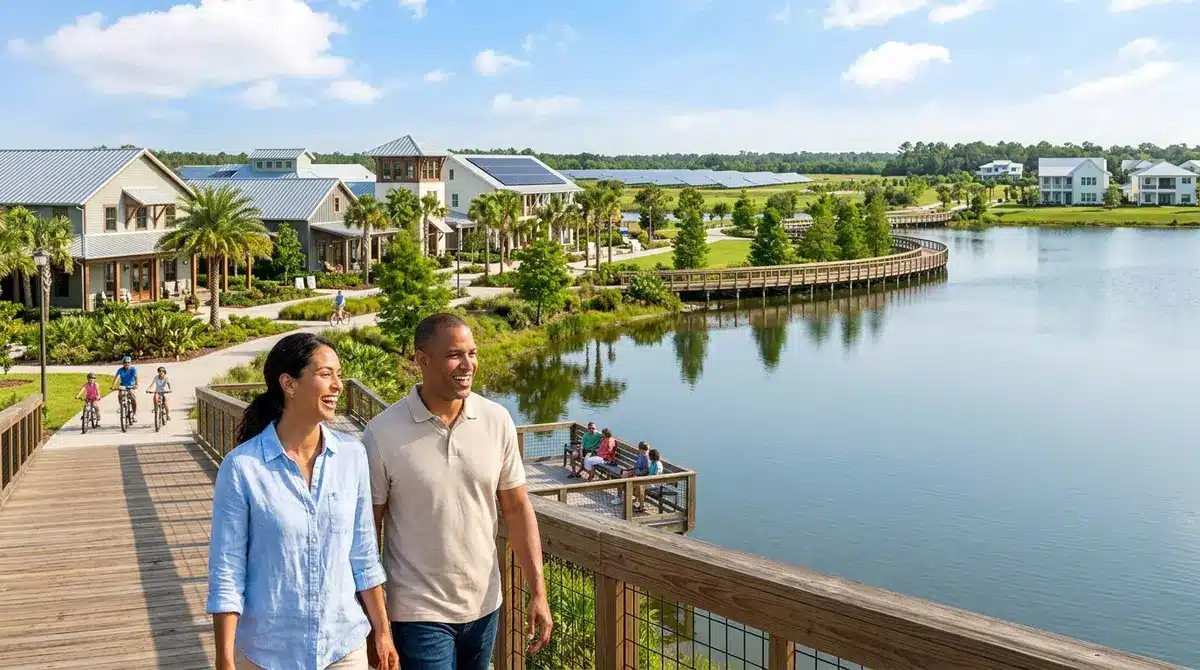

When you first drive past the solar trees and into Founder’s Square, the vision of Babcock Ranch is clear: it is the “Hometown of Tomorrow.” It is a place where sustainability meets modern convenience, safe from the storm surges that threaten the coast. However, as you dig deeper into the finances of buying a home here, you will encounter line items that might be unfamiliar, specifically regarding property taxes and Community Development District (CDD) fees. A common question we receive from prospective buyers is, “How do property taxes in Babcock Ranch impact the affordability of homes here?”
The answer is multifaceted. While the initial monthly numbers may appear higher than in older, non-amenitized communities, the “Total Cost of Ownership” often tells a different story. By understanding the interplay between taxes, infrastructure bonds, and insurance savings, you can see how Babcock Ranch offers a financial stability that is increasingly rare in the Florida market.
Key Takeaways
- The “All-In” Tax Rate: When estimating your carrying costs, it is safe to calculate approximately 1.7% to 1.8% of your home’s purchase price to cover both county property taxes and CDD fees.
- CDD Explained: The Community Development District (CDD) fee is not a tax; it is a repayment of the bond used to build the community’s resilient infrastructure, solar arrays, and water management systems.
- Insurance Offsets: Because of our high elevation (30 feet above sea level) and storm-hardened construction, homeowners insurance rates here are often significantly lower than in coastal Lee or Charlotte County, offsetting higher tax bills.
- Utility Savings: High-efficiency homes and solar integration mean monthly electric bills are frequently lower than the regional average, improving overall monthly cash flow.
- Resale Value Protection: The infrastructure funded by your taxes creates a “floor” for property values, as evidenced by the community’s resilience and popularity post-Hurricane Ian.
Overview: The Financial Landscape of a Master-Planned Town
In this comprehensive guide, we will break down the specific components of your monthly payment. We will look beyond the sticker price of the home and analyze the tax bills, the specific debt service portions of the CDD, and how these figures vary between neighborhoods like Lake Timber and the newer enclaves in MidTown.
We will also explain why navigating this financial terrain alone is risky. Many generic mortgage calculators fail to account for the specific CDD structures of Babcock Ranch, leading to “payment shock” at the closing table. We assist buyers by providing accurate, lot-specific data so you know exactly what your monthly investment looks like before you sign a contract.
Deconstructing the Property Tax Bill

To understand how do property taxes in Babcock Ranch impact the affordability of homes here, you must first distinguish between Ad Valorem taxes and Non-Ad Valorem assessments.
Ad Valorem Taxes (The Standard Property Tax)
This is the tax based on the assessed value of your home, levied by Charlotte County (and Lee County for the southernmost section). This rate fluctuates based on the millage rates set by the county commission and school board. Currently, the millage rate in our area is competitive with the rest of the region. If you are a permanent Florida resident, you can significantly reduce this portion of your bill through the Homestead Exemption, which can exempt up to $50,000 of your home’s assessed value from taxation and cap annual assessment increases at 3% via the “Save Our Homes” amendment.
Non-Ad Valorem Assessments (The CDD Fee)
This is the confusing part for many newcomers. Babcock Ranch is an Independent Special District. The developer issued bonds to pay for the massive infrastructure upfront—the roads, the underground utilities, the water management lakes, and the amenities. Instead of the developer inflating the home price by $40,000 or $50,000 to cover this, the cost is attached to the land as a bond.
You pay this back over 20 to 30 years as a “CDD Fee” on your tax bill. This fee has two parts:
- Debt Service: A fixed annual amount that goes toward paying off the bond. This amount is tied to your lot size (e.g., a 50-foot lot pays less than an 80-foot lot).
- Operations & Maintenance (O&M): A variable amount that pays for the day-to-day upkeep of the community’s common infrastructure.
The Affordability Equation: Taxes vs. Living Costs

When buyers ask us, “Is Babcock Ranch affordable with these high fees?”, we ask them to look at the whole picture. You cannot look at the tax line in isolation. You must calculate the Total Cost of Ownership.
The Insurance Arbitrage
In many parts of Cape Coral or Fort Myers, property taxes might be lower because there is no CDD fee. However, homeowners in those older, low-elevation areas are often paying $4,000 to $8,000 annually for flood and wind insurance. At Babcock Ranch, because we are in “Flood Zone X” (minimal risk) and our homes are built to the latest wind codes, insurance premiums are often 30% to 50% lower. For many of our clients, the savings on insurance completely neutralize the cost of the CDD fee.
Energy Independence
Another factor impacting affordability is the cost of power. Your taxes help fund a community designed for energy efficiency. All homes must achieve a Bronze level or higher certification from the Florida Green Building Coalition. This means superior insulation, high-efficiency HVAC systems, and lower electric bills. While your neighbor in an older town pays $300 a month to cool their home in August, your bill might be half that.
Neighborhood Variations: Not All Lots Are Taxed Equally
The impact of property taxes on affordability varies significantly depending on where in Babcock Ranch you buy.
The “Established” Neighborhoods: Lake Timber & Parkside In the original neighborhoods like Lake Timber, the infrastructure is already mature. The trees are grown in, and the parks are complete. The CDD fees here were set during the initial bond issuance. While high, they support the premium location near Founder’s Square. Buyers here are paying for walkability and the “town square” lifestyle.
The New Frontier: MidTown and Edgewater As development moves into MidTown, the bond structures may differ. Construction costs for infrastructure have risen, which can sometimes result in higher Debt Service portions for new phases compared to the original ones. However, builders in these areas often offer incentives that can buy down your interest rate, effectively lowering your monthly payment to offset the tax burden.
The Golf Premium: Babcock National If you are looking at Babcock National, you must be careful. In addition to taxes and CDD fees, you have bundled golf memberships. While this provides an incredible resort lifestyle, it drastically changes the affordability calculation. The mandatory fees cover your access to the course and amenities, but they are a fixed monthly cost that you must budget for on top of your annual tax bill.
The Role of Professional Guidance
This complexity is exactly why we discourage DIY home searching. If you rely on Zillow’s estimated monthly payment, you will likely be wrong. Third-party sites rarely calculate the specific CDD fee for a specific lot size. They often apply a generic county tax rate that misses the Non-Ad Valorem assessments entirely.
We help you by obtaining the specific “tax roll” data for the property you are interested in. We can show you exactly how much of the tax bill is the fixed bond (which disappears after 30 years) and how much is the true tax. We also help you identify homes where the seller may have already paid off the CDD bond in full—a rare but massive value that instantly improves affordability.
The Hidden “Exit Tax” and Other Considerations
Transparency is our core value. Beyond the annual taxes, you need to be aware of the Community Enhancement Fee. This is a transfer fee of roughly 0.25% of the sale price, paid to the community organization whenever a home is sold. While this does not impact your monthly affordability, it is a cost to consider when calculating your eventual return on investment.
However, this fee stays in the community. It funds the lifestyle events, the concerts, and the upkeep that keeps property values high. It is a reinvestment in your own asset.
Why “High” Taxes Can Mean Better Value
Ultimately, affordability is relative to value. In Babcock Ranch, your taxes are paying for a guarantee of performance. During Hurricane Ian, our residents did not lose power. They did not lose water. They did not have flood water in their living rooms. The “tax” you pay here is essentially a premium for safety and continuity.
For many buyers relocating from states with high income taxes, the Florida tax structure—even with the CDD—is a relief. There is no state income tax here. The property tax is the primary vehicle for funding local services. When you see the pristine condition of our parks, the quality of the Babcock Neighborhood School, and the safety of our streets, it becomes clear that the tax revenue is being deployed effectively.
Business Information
The team at All Babcock Ranch Homes understands that buying a home is a financial portfolio decision, not just an emotional one. We are located at Babcock Ranch and can be reached at 518-569-7173. Whether you are looking for a villa or a custom estate, email us at andrelafountain@gmail.com for a detailed tax worksheet on your preferred neighborhood.
Common Questions About How Do Property Taxes in Babcock Ranch Impact the Affordability of Homes Here?
Q: Is the CDD fee tax-deductible? A: Generally, the “Debt Service” portion of the CDD fee is not tax-deductible on your federal return, as it is considered a payment for improvements to your property. However, the “Ad Valorem” property taxes are typically deductible up to the federal limit. We recommend consulting a tax professional for your specific situation.
Q: Can I pay off the CDD fee in advance? A: Yes, you can usually pay off the “Debt Service” portion of the CDD bond in a lump sum. This removes that line item from your annual tax bill for the remainder of your ownership, significantly lowering your monthly carrying costs and improving the home’s resale marketability.
Q: Do all neighborhoods in Babcock Ranch have the same tax rate? A: No. While the county millage rate is consistent, the CDD assessments vary by neighborhood and lot size. A 50-foot lot in Parkside will have a different assessment than a condo in Babcock National. We can provide a fee sheet comparing these specific differences.
Q: How does the Homestead Exemption affect affordability? A: If this is your primary residence, the Homestead Exemption reduces your home’s assessed value by up to $50,000 for non-school taxes. More importantly, it caps the annual increase in your assessed value at 3%, protecting you from tax spikes if property values soar.
Q: What is the difference between the HOA fee and the CDD fee? A: The CDD fee is collected via your annual property tax bill and funds public infrastructure (roads, lakes). The HOA fee is paid monthly or quarterly to a management company and funds private amenities like high-speed internet, lawn care (in some neighborhoods), and clubhouse access.
Q: Will my property taxes go up every year? A: Your Ad Valorem taxes may increase if your home’s assessed value rises or if local government millage rates increase. However, the Debt Service portion of your CDD fee is fixed. The O&M portion of the CDD may fluctuate slightly with the district’s budget but is generally stable.
Q: How do Babcock Ranch taxes compare to Lakewood Ranch? A: Both communities utilize CDD fees to fund infrastructure. Generally, the tax burdens are comparable, but Babcock Ranch often offers lower insurance premiums and energy costs due to its newer, storm-hardened infrastructure and inland location, which can result in a lower total cost of ownership.
Q: Does the school system impact my property taxes? A: Yes, a portion of the county millage rate goes toward funding Charlotte County Public Schools. Additionally, the success of the Babcock Neighborhood School helps maintain high property values, which indirectly supports the tax base and community desirability.
Conclusion
When you ask, “How do property taxes in Babcock Ranch impact the affordability of homes here?”, you are asking the right question. It shows you are a savvy buyer looking for the truth behind the numbers. While the line items on the tax bill may seem numerous, they fund a lifestyle of unparalleled safety, sustainability, and community. Contact us today to discuss your options.
By reviewing Babcock Ranch Real Estate Market Trends, you can better understand Property Prices in Babcock Ranch. Our Babcock Ranch Home Buying Guide provides a Babcock Ranch Housing Market Analysis to ensure you make an informed decision.