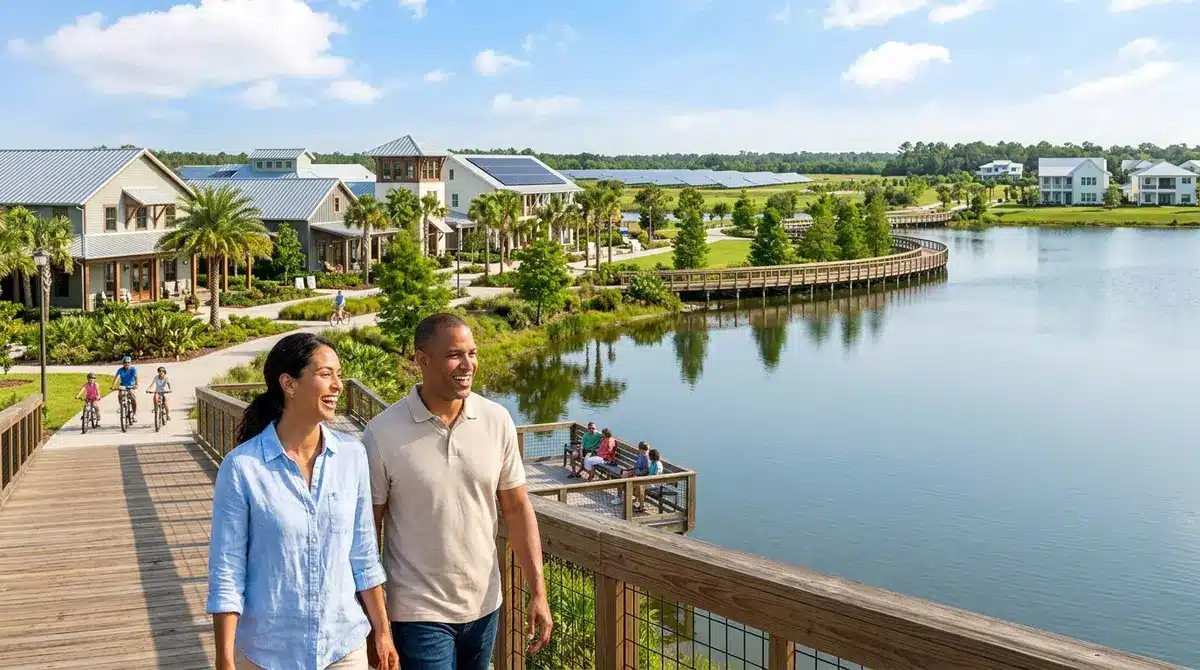

The phrase “solar powered community” gets used a lot in real estate and sustainability conversations — often loosely, in contexts where a few rooftop panels or a shared community solar subscription is labeled a community-scale achievement. Babcock Ranch, located in Charlotte County, Florida, is not that. It is the first town in the United States built from the ground up as a solar powered community in the full operational sense of that term — with a utility-scale solar array, battery storage, an advanced fiber-optic network, and a Florida Green Building Coalition Platinum certification that governs every home built within its boundaries. The distinction matters, because buyers and investors evaluating this community deserve an accurate understanding of what the solar infrastructure actually consists of and what it practically delivers, rather than a marketing-level description that could apply to dozens of other developments across Florida.
This guide gives you the full, data-grounded picture of what Babcock Ranch’s solar powered community infrastructure includes — how it was built, how it works, what it has delivered through multiple hurricane seasons, what it means for your electricity bills as a resident, and what all of it says about the long-term investment case for owning property here. The Hometown of Tomorrow has been operating with real residents for nearly eight years now. The results are documented. And if you are at the point in your research where you want the substantive detail behind the headline, this is the guide you have been looking for.
Key Takeaways
- Babcock Ranch’s solar powered community infrastructure consists of an 870-acre solar farm operated by Florida Power & Light, housing two solar energy centers — the FPL Babcock Ranch Solar Energy Center and the FPL Babcock Preserve Solar Energy Center — with 680,000 solar panels generating 150 megawatts of clean energy.
- The National Renewable Energy Laboratory estimates that 149 megawatts of photovoltaics at Babcock Ranch’s latitude produce approximately 230,700,534 kWh annually — a generation capacity that exceeds the community’s current residential demand and feeds surplus energy back to the broader FPL grid for surrounding areas to use.
- On average, Babcock Ranch homes are 24% more energy-efficient than homes built to the Florida Energy Code standard, and residents consistently report electricity bills running significantly below Southwest Florida regional averages.
- The community’s solar and battery storage infrastructure maintained power continuously during Hurricane Ian (September 2022) and Hurricane Milton (October 2024) while surrounding Lee and Charlotte County communities experienced extended outages lasting days to weeks.
- Every home built at Babcock Ranch must receive a Bronze Standard certification or higher from the Florida Green Building Coalition — a binding requirement embedded in the community’s governing documents, not a voluntary builder preference.
- Babcock Ranch holds a Platinum certification from the Florida Green Building Coalition — the highest level available — making it the most rigorously certified solar powered community in Florida by that standard.
Overview
This guide covers everything a buyer, investor, or prospective resident needs to understand about Babcock Ranch as a solar powered community — from the physical infrastructure and its generation specifications, to what the solar system delivers in practical terms for homeowners, to how the green building standards embedded in the community’s governing documents maintain energy performance across every home regardless of builder. We also address how the storm resilience story connects to the solar infrastructure, what the energy cost data looks like for current residents, how the community’s sustainability credentials affect its real estate market position, and what buyers should understand about green building certification when evaluating individual homes within the community. A comprehensive FAQ section covers the most specific questions buyers bring to us about the solar infrastructure and its implications for ownership costs and investment performance.
The Solar Infrastructure: Specifications That Actually Matter to Homeowners

The FPL Babcock Ranch Solar Energy Center and FPL Babcock Preserve Solar Energy Center together occupy 870 acres of land within the Babcock Ranch development — land provided by developer Kitson & Partners to Florida Power & Light as part of the partnership agreement that made the solar powered community model financially viable for both parties. The two centers house 680,000 solar panels that collectively generate 150 megawatts of clean renewable energy. This generation capacity is not sized to match current residential demand — it substantially exceeds it. The community’s current resident population uses a fraction of the total generation output, with the surplus feeding back into FPL’s regional grid to power surrounding communities. As Babcock Ranch’s build-out continues and the resident population grows, the generation-to-consumption ratio will shift, but the infrastructure capacity was built to serve the community at full build-out rather than being sized for the development’s early phases.
The battery storage component is the element that most directly affects residents during weather events. During normal operating conditions, the solar panels generate power through daylight hours and the battery system stores excess capacity that supplements overnight and overcast-day supply. During grid disruptions — the scenario that Southwest Florida residents experienced during Hurricanes Ian and Milton — the battery storage system maintains power continuity for the community’s homes and critical infrastructure independently of the broader regional grid. This is not a backup generator scenario that kicks in for a few hours; it is a sustained continuity infrastructure that kept Babcock Ranch’s residents powered for the full duration of both storms and their immediate aftermath. The Florida Power & Light solar energy program documents the ongoing expansion and operational management of the Babcock Ranch Solar Energy Centers as part of its larger commitment to renewable generation capacity across Florida. For buyers who want the full technical picture of how the solar infrastructure was built and how it integrates with the broader FPL system, our in-depth resource on the Babcock Ranch solar energy community covers the infrastructure mechanics in detail.
How the Community Became America’s First Solar Powered Town
The first residents moved into Babcock Ranch on January 4, 2018, before the community’s official grand opening in March of that year — making Babcock Ranch the first town in the United States to open as an operational solar powered community from day one of occupancy. This was not a retrofit or a gradual transition to renewable energy; the solar field was completed before the first home was occupied, which meant that every resident who moved in from the start received solar-sourced power as their standard utility supply. This sequencing was intentional and required years of advance coordination between Kitson & Partners and FPL to execute. The partnership model — developer provides land at no cost, FPL builds and operates the generation infrastructure — is the financial structure that made the utility-scale solar investment viable without adding a direct solar premium to individual home prices. Residents pay standard FPL utility rates, not a premium rate for the solar sourcing, which is a practical detail that matters enormously to the real-world cost advantage the solar powered community delivers.
What the Solar Infrastructure Means for Your Electricity Bill

The most practically significant element of living in a solar powered community for most buyers is the impact on monthly electricity costs. Babcock Ranch homes average 24% greater energy efficiency than homes built to Florida’s standard Energy Code — a differential that comes from the Florida Green Building Coalition certification requirements that every builder in the community must meet. This baseline efficiency, combined with the solar generation infrastructure, produces electricity bills that residents consistently describe as well below what they paid in comparable or larger homes elsewhere in Southwest Florida or in their previous Northern markets. The surplus generation that feeds back to the regional grid does not generate direct financial credits for individual Babcock Ranch homeowners — the solar system operates at the utility scale through FPL rather than through individual rooftop net metering — but the rate environment and the homes’ efficiency combine to deliver cost outcomes that have been confirmed across a large enough sample of resident reports to represent a genuine, reliable advantage rather than an outlier experience.
For buyers modelling total cost of ownership, this energy cost advantage is a real line item that offsets a portion of the CDD and HOA fees that the community carries as a master-planned development. A buyer who pays $150 to $200 per month less in electricity than they would in a comparable home in a conventional Southwest Florida community is realizing a measurable annual savings that compounds over the life of ownership. For investors, lower utility costs reduce the all-in operating cost of a rental property and improve net yield calculations. For retirees on fixed incomes, the budget predictability that comes from consistently lower energy costs is a planning advantage that financial advisors consistently cite as significant in Florida’s increasingly hot climate. The U.S. Department of Energy’s community solar resource provides additional context on how community-scale solar generation translates into cost outcomes for residential participants in various program structures — background that helps buyers understand where Babcock Ranch’s model fits within the broader landscape of solar powered community approaches across the country.
Green Building Certification: What It Means for Every Home You Consider
Every home built within Babcock Ranch must receive a Bronze Standard certification or higher from the Florida Green Building Coalition (FGBC) — a requirement that is embedded in the community’s governing development agreements and enforced through the builder approval and inspection process. This is not a builder marketing claim or a voluntary program that some builders in the community choose to participate in; it is a binding standard that applies to every home regardless of which builder produced it or which product tier it sits in. FGBC certification covers energy efficiency, water conservation, indoor air quality, materials sourcing, and landscaping standards — it is a comprehensive evaluation, not a single-metric approval. The community itself holds a Platinum FGBC certification at the master development level, which is the highest designation available and reflects the full scope of the community’s sustainable infrastructure rather than just its solar generation. For buyers comparing homes across different Babcock Ranch neighborhoods and builders, this certification standard is the baseline quality floor that applies across the board — it means that a home in Edgewater and a home in Lake Timber are both meeting the same minimum energy and environmental performance standards regardless of their price difference.
Storm Resilience: The Solar System’s Most Visible Proof Point
The hurricane performance data is the most empirically compelling evidence for what a properly engineered solar powered community delivers in Southwest Florida’s risk environment. When Hurricane Ian made landfall near Fort Myers in September 2022 as one of the most powerful Atlantic hurricanes ever recorded at that location, Babcock Ranch maintained continuous power through the storm and its aftermath. The community’s homes, infrastructure, and common areas operated normally while surrounding Lee and Charlotte County communities lost power for periods ranging from several days to several weeks in the hardest-hit areas. Babcock Ranch became a functioning shelter for displaced residents from Fort Myers, Cape Coral, and surrounding communities — a reversal of the expected dynamic in which newer suburban developments are typically more vulnerable than established urban infrastructure. The Urban Land Institute’s case study of Babcock Ranch’s Ian performance confirmed the community’s resilience credentials with the kind of third-party documentation that carries weight beyond developer marketing.
When Hurricane Milton struck in October 2024, the performance was consistent. Babcock Ranch maintained power again. Two major storm events. Two verified outcomes. For buyers from the Northeast, Midwest, or other hurricane-inexperienced markets who are evaluating Florida real estate for the first time, this two-storm track record is a data point that carries more weight than almost anything else in the community’s story. Power continuity during a major storm is not just a comfort — it is a safety and security issue with direct implications for the physical condition of your home, the functionality of your appliances and climate control, the preservation of food and medications, and your family’s ability to shelter safely in place. The solar powered community infrastructure at Babcock Ranch has provided this continuity in exactly the conditions that matter most. Our analysis of Babcock Ranch’s Hurricane Ian performance covers the documented outcomes in full detail, including resident accounts and third-party case study findings that provide the most complete picture of what actually happened during and after the storm.
How the Solar Powered Community Model Affects Real Estate Value at Babcock Ranch
The investment case for Babcock Ranch real estate is shaped in part by what the solar powered community infrastructure does to buyer demand. Since Hurricane Ian, the community has attracted a buyer profile that is specifically choosing solar resilience and energy independence as purchase criteria — a demand driver that extends beyond Southwest Florida’s traditional retirement and seasonal relocation market to include buyers from across the country who prioritized storm-safe, energy-efficient housing after watching Ian’s impact on the region from a distance. This broader national demand base has supported price stability in Babcock Ranch through market cycles that affected other Southwest Florida communities more significantly, and it represents a demand characteristic that is tied directly to the community’s infrastructure rather than to general regional market conditions. The Florida Realtors Research Division has documented that energy efficiency features and storm resilience rank among the highest-priority buyer motivators in Florida’s post-2020 market — a trend that directly advantages a solar powered community with Babcock Ranch’s verified performance record.
The 24% energy efficiency advantage over standard Florida Energy Code homes also has a direct appraisal and underwriting implication. As Florida’s insurance market has tightened significantly since Hurricane Ian — with many carriers exiting the state or dramatically increasing premiums — homes that meet or exceed FGBC certification standards and that are located in communities with documented storm resilience have experienced more favorable insurance pricing than comparable homes in less-resilient locations. This insurance cost differential is an additional component of the total ownership cost advantage that the solar powered community model delivers — one that compounds over time as insurance costs continue to be a significant variable in Florida homeownership economics. Our detailed guide to Babcock Ranch as an investment covers the full investment analysis including energy cost savings, insurance considerations, price appreciation data, and how the solar infrastructure factors into the long-term hold case for properties at different price tiers within the community.
Technology Integration Beyond Solar: What Else the Community Includes
The solar powered community designation covers the most visible and widely reported element of Babcock Ranch’s technology infrastructure, but it is not the full picture of what the community’s technology platform includes. Babcock Ranch operates on an advanced fiber-optic network that serves every home in the development — a high-speed internet infrastructure that was built into the community’s design from the earliest planning stages rather than added after the fact. For the large proportion of Babcock Ranch residents who work remotely, this network is a foundational amenity that makes the community’s inland location a non-issue for professional connectivity. The community also features solar trees in Founder’s Square and neighborhood parks — public art installations that function as device charging stations and serve as physical markers of the solar powered community identity in the community’s most social spaces. Electric vehicle infrastructure, including charging station access, is integrated into the community’s design in anticipation of the resident population’s continued shift toward EV ownership. These technology layers work together to give the community a practical infrastructure sophistication that is unusual in a master-planned development at any price point.
Talk to Our Team About What the Solar Powered Community Means for Your Purchase
At What Are the Experiences of Buyers Who Went Through the Purchasing Process in Babcock Ranch?, we work with buyers and investors at every stage of the Babcock Ranch purchasing process — from initial community orientation and green building certification evaluation to contract review, builder comparison, and long-term investment planning. Understanding what a solar powered community delivers in practical, financial terms for your specific situation — your budget, your energy usage patterns, your storm resilience priorities, and your investment horizon — is a conversation our team has regularly and thoroughly. Reach us at 518-569-7173 or email andrelafountain@gmail.com to schedule a conversation before you walk into a show home and make decisions based on sales center presentations alone.
Common Questions About Solar Powered Community
What exactly makes Babcock Ranch a solar powered community?
Q: What exactly makes Babcock Ranch a solar powered community?
A: Babcock Ranch is powered by a utility-scale solar infrastructure consisting of two FPL solar energy centers on 870 acres of land within the development, housing 680,000 solar panels that generate 150 megawatts of clean energy. The system operates with battery storage for continuity during grid disruptions. All homes are required to meet Florida Green Building Coalition certification standards. The community opened in 2018 as the first operational solar powered town in the United States.
Do Babcock Ranch homeowners get cheaper electricity because of the solar farm?
Q: Do Babcock Ranch homeowners get cheaper electricity because of the solar farm?
A: Babcock Ranch homeowners pay standard FPL utility rates — there is no direct solar-sourcing discount or individual net metering from the community’s solar farm. However, homes average 24% greater energy efficiency than standard Florida Energy Code construction, and residents consistently report electricity bills running well below Southwest Florida regional averages. The combination of the community’s solar infrastructure and mandatory green building standards produces a measurable cost advantage over time.
How did Babcock Ranch’s solar powered community perform during Hurricane Ian?
Q: How did Babcock Ranch’s solar powered community perform during Hurricane Ian?
A: Babcock Ranch maintained continuous power throughout Hurricane Ian’s September 2022 landfall and the recovery period that followed, while surrounding communities in Lee and Charlotte counties experienced outages lasting days to weeks. The community became a storm shelter for displaced residents from Fort Myers, Cape Coral, and surrounding areas. The same outcome occurred during Hurricane Milton in October 2024, creating a two-storm verified resilience record supported by third-party documentation from the Urban Land Institute.
Does every home in Babcock Ranch have solar panels on the roof?
Q: Does every home in Babcock Ranch have solar panels on the roof?
A: No. The solar powered community model at Babcock Ranch operates through a utility-scale solar farm rather than through individual rooftop panels. The FPL solar energy centers on 870 acres of land within the community supply solar-generated electricity to homes through the standard FPL utility distribution system. Individual homeowners can install additional rooftop solar if they choose, but the community-level solar infrastructure does not depend on or require rooftop panels on individual homes.
What green building standards apply to all Babcock Ranch homes?
Q: What green building standards apply to all Babcock Ranch homes?
A: Every home built at Babcock Ranch must receive a Bronze Standard certification or higher from the Florida Green Building Coalition — a binding requirement embedded in the community’s governing development agreements rather than a voluntary builder option. FGBC certification covers energy efficiency, water conservation, indoor air quality, materials sourcing, and landscaping standards. The Babcock Ranch master development itself holds a Platinum FGBC certification — the highest designation available in the program.
How does the solar infrastructure at Babcock Ranch compare to community solar programs elsewhere?
Q: How does the solar infrastructure at Babcock Ranch compare to community solar programs elsewhere?
A: Most community solar programs are subscription-based models that give households access to shared solar capacity through bill credits — they do not involve dedicated on-site generation infrastructure. Babcock Ranch’s model is a utility-scale, purpose-built solar energy center on land within the development itself, paired with battery storage, built and operated by FPL before the first home was occupied. It is a fundamentally different scale and integration than a subscription community solar program.
Is the surplus energy from Babcock Ranch’s solar farm shared with surrounding communities?
Q: Is the surplus energy from Babcock Ranch’s solar farm shared with surrounding communities?
A: Yes. The solar energy centers at Babcock Ranch generate 150 megawatts of capacity — significantly more than the community’s current residential demand. The surplus generation feeds back into FPL’s regional grid, providing clean solar energy to surrounding communities in Charlotte and Lee counties. This surplus-to-grid feature is built into the system design and reflects the community’s intention to contribute to regional clean energy supply, not just to serve its own residents.
What other technology features does Babcock Ranch include beyond solar power?
Q: What other technology features does Babcock Ranch include beyond solar power?
A: Babcock Ranch includes a community-wide fiber-optic high-speed internet network serving all homes, solar trees in Founder’s Square and neighborhood parks that function as public device charging stations, electric vehicle charging infrastructure integrated into the community’s design, and reclaimed water irrigation systems that reduce fresh water consumption across the development. These technology layers work together to give the solar powered community a practical infrastructure sophistication beyond the solar generation headline.
How does living in a solar powered community affect home insurance costs in Florida?
Q: How does living in a solar powered community affect home insurance costs in Florida?
A: Florida’s insurance market has tightened significantly since Hurricane Ian, with many carriers increasing premiums or exiting the state. Homes that meet FGBC certification standards and are located in communities with documented storm resilience records have generally experienced more favorable insurance pricing than comparable homes in less-resilient locations. While individual insurance outcomes vary by carrier, coverage type, and specific home characteristics, the solar powered community’s verified hurricane performance record is a positive factor in the insurance underwriting environment.
Conclusion
Babcock Ranch’s position as America’s first solar powered community is not a brand promise — it is an operational reality that has been tested through two major hurricane seasons and validated by the residents, researchers, and third-party observers who documented what actually happened. The 680,000 solar panels, the 870-acre energy centers, the 24% efficiency advantage in every home, the platinum green building certification, and the continuous power supply through Ian and Milton collectively represent the most thoroughly tested solar powered community infrastructure in the United States. For buyers who want that infrastructure to be part of their daily life, their ownership costs, and their long-term investment, Babcock Ranch is not just a compelling option — it is the only verified example of its kind at scale in the country.
If you want to understand how the solar powered community at Babcock Ranch translates into a specific purchase decision — which neighborhoods, which floor plans, which builders, and which price points give you the best alignment with your priorities — our team at What Are the Experiences of Buyers Who Went Through the Purchasing Process in Babcock Ranch? is ready for that conversation. Call 518-569-7173 or email andrelafountain@gmail.com and let us help you move from research to decision with the full picture. For a broader look at how this community compares to alternatives in Southwest Florida, our resource on comparing Babcock Ranch to other markets provides the side-by-side analysis that buyers at this stage of their research most consistently find useful.